All herald the hoar-frost…!

frost

As I stepped outside for my dawn walk this morning, a familiar stranger was waiting to greet me. The earth lay glimmering with a myriad tiny shards of ice and a new ‘bite’ was in the air; one that nipped viciously at my nose and fingers.

The first of the hoar-frosts had come.

I jumped back into the house and went to reacquaint myself with another old friend… the much loved Winter-coat! The light-weight Summer jacket was suddenly out of its depth. The icy grip of Winter is on its way!

One of my most treasured possessions is my brown leather bomber-jacket. I love it so much I’ve even snapped a picture of it to show you! It is ‘buttery soft’, with a thick downy padding that cossets you against the cold. This lends it a pleasing, sturdy weight, in spite of its softness. When you wear it, it whispers silently “I’ll shield you from anything”.

As I chugged ’round the field in my wellington-boots, my breath puffing and condensing like a steam-train;  I buried my hands deep into the pockets of my favourite jacket.

I smiled and was happy.

jacket

Thank you for reading and enjoy the day,

Adam.

Warm ‘Greek-Style’ Chicken Salad with Roasted Aubergine, Courgette, Basil & Halloumi – Low-carb Autumn-fare that clings to the taste of Summer!

salad

When we think of traditional Autumn-fare, the mind conjures up thick stews and casseroles; roasted pumpkins, soups and sausages; all served up in thick chunky bowls to warm the hands and heart.

But that doesn’t mean we’re limited to such dishes. There can still be variety that’s both hearty and fresh, paying tribute to the last of the Summer. This recipe is exactly that!

The final solitary tomato from my garden has been sacrificed for this dish. Aubergines are still readily available and herbs staunchly retain their perfume, undiminished by the mists and encroaching chill.

Because this is a ‘warm salad’, it truly offers the best of both worlds! The fresh flavours of Summer are present in the basil, rocket and rich tang of olive-oil; but the comfort-qualities of Autumn equally abound, with oven-baked vegetables, salty griddled cheese and hot, succulent roast-chicken.

This tribute to the change in seasons can be enjoyed by diabetics, gluten-intolerants, paleo-fans and ketogenic-dieters alike! Curl up by the fire, but eat a taste of the sun. We need it in food; as darkness & cold slowly rob it from all place else!

Place your chicken-pieces into a roasting-tray and generously salt and pepper the skins. Sprinkle on some dried oregano and oven for one hour until the chicken is golden and brown.

Meanwhile, roughly dice your aubergine, courgette and red-onion and glug over some good quality olive-oil to coat. Mix in crushed garlic, chopped Greek-basil and season well. Place into the oven and bake for the same duration as the chicken.

Slice your halloumi and place it onto a baking-sheet, ready to be grilled 10 minutes before serving.

Arrange a mixture of lettuce, rocket-leaves, diced tomato, olives, peppers and radish in your salad-bowl. Leave a well in the centre to pile up your hot ingredients, so that the salad doesn’t wilt.

Take your chicken and vegetables out of the oven and set them aside for ten minutes, so that they lose a little of their heat. Then place your halloumi under the grill, with a light drizzle of oil. Turn once halfway through so that both sides get their share of the suntan.

Tumble the vegetables into the centre of your salad-bowl, then arrange the cooked cheese at reliable intervals. Top this with your chicken-pieces, more chopped Greek-basil and a final salute of olive-oil.

Hey presto! Dinner is served! And I can honestly say, if you don’t like this, then there’s no pleasing you!

Thanks for reading and bon ap!

Adam.

Keto-Cocktails – Gin is ‘in’!

gin

Alcohol is never great for a diet, but let’s face it; we’re all human! As long as a degree of moderation is applied, a little bit of what you fancy won’t go too far astray! When first starting a diet, it’s best to avoid alcohol for two weeks; but after that, it can start making the odd guest appearance of an evening. I’ve lost 11 pounds in 5 weeks, drinking alcohol from week 3. The proof is therefore in the pudding!

I must admit to being partial to a good stiff tipple. The carb-count of beer and wine is prohibitive for weight-loss; but thankfully one of my firm favourites is well and truly on the cards – the majestic & dependable gin & tonic.

This has been a stalwart of English life for the past 300 years. Also known as “mother’s ruin”; I can think of few things I’d rather be ruined by than this. Sadly, so many people get it wrong, and produce something which is wholly disappointing and indifferent at best. Like everything in life, gin must be done properly. There’s no excuse for failure.

Crisp, clean and refreshing is what you’re aiming for. The glass must be long, with lots of ice and a good squeeze of lime. Nothing else will do. I’m not snobby about which gin you use. Yes, some are better than others; but how you make it is by far the most important factor.

The bottle states 0g of carbohydrate; the Atkins website states 0.1g net carbs per 100ml. Either way it’s no great shakes! A couple of these whilst preparing dinner, adds verve and pizzaz to the cooking experience. So try it my way, and get back to me with the results!

Take a tall glass. Yes, tall. Half fill with ice, then run a lime wedge liberally around the rim of the glass. Pour in your gin, then squeeze the lime wedge over the gin and swirl the glass. Fill to the brim with fresh, fizzy Indian tonic-water (diet), then take a good long sip whilst the bubbles are still effervescent enough to tickle your nose.

Heaven in a glass!

Thanks for reading and bottoms up!

Adam.

P.S. – one gin and tonic; two gins and tonic. Getting this wrong in polite English society will mean you’re never invited back!

The Low-Carb Shopping-List – Keto-GO-GOs!

Shopping can be a little intimidating when starting a low-carb, ketogenic diet. A once-familiar supermarket can suddenly become an alien place, full of ‘out-of-bounds-foods’ and temptation.

To ease this process, I’ve put together a shopping-list to cover all the main areas; fresh-produce, meat, dairy & store-cupboard. This list is also applicable to diabetics and those on a gluten-free diet.

For specific items which may not be on this list; remember to follow the golden-rule of net-carbs. I hyperlink this below for reference.

Further information on carb-content for specific vegetables can be found on the second link.

Calculating Net Carbs

List of Low-Carb Vegetables

Keto-GO-GO Shopping List:

Fruit & Vegetables
Aubergine
Avocado
Blackberries (few)
Blueberries (few)
Broccoli
Cabbage
Cauliflower
Celeriac
Celery
Chillies
Courgette
Cucumber
Garlic
Green Beans
Herbs
Leeks
Lemons
Lettuce (all sorts)
Limes
Mange Tout
Mushrooms
Onions
Peppers
Radishes
Raspberries (few)
Spinach
Sugar-Snap Peas
Watercress

Dairy
Butter – Salted & Unsalted
Cheese – Blue e.g. Stilton
Cheese – Hard e.g. Cheddar
Cheese – Hard Grating e.g. Parmesan
Cheese – Slicing e.g. Emmental
Cheese – Soft Salad e.g. Feta
Cheese – Soft Rinded e.g. Brie
Cheese – Spreading e.g. Philadelphia
Double Cream
Eggs

Meat
Bacon
Beef
Chicken
Cured Meats e.g. Salami (check label for carbs)
Duck
Game – e.g. Pheasant
Ham
Lamb
Pork
Sausages

Fish
Crab
Lobster
Mackerel
Mussels
Prawns / Crevettes
Salmon (Smoked & Fresh)
Scallops
Shrimp
Sole
Squid
Tuna (Fresh)

Store-Cupboard / Larder
Anchovies
Bicarb of Soda
Cocoa
Dried Herbs
Dried Spices – All e.g. Paprika
Flaked Almonds
Flaxseed
Ground Almonds
Maccadamia Nuts (few)
Mayonnaise
Mustard (Unsweetened)
Oil – Olive
Oil – Sesame or Stir-Fry Oil
Oil – Sunflower
Olives
Seasoning (Salt / Pepper)
Stock Cubes
Suet
Sweetener – Baking e.g. Xylitol
Sweetener – Table e.g. Splenda
Tinned Tuna
Vanilla Pods / Seed Powder

The list is by no means exhaustive, but it should serve as a fairly comprehensive guide to the basics. There’s no need to buy it all at once. That would bankrupt most of us! Especially for the store-cupboard section; if you don’t already have something, then stock up your larder week by week.

It all may seem a little expensive in comparison to the cheap, high-carb nasties. It’s worth keeping in mind however, that after a week or so, the volume of food you’re consuming will decrease rapidly. This is because saturates make you feel full on a smaller quantity and the ketogenic-diet is brilliant at suppressing hunger-pangs! After a month, it should all balance out nicely, as your food-cupboard & fridge gets fully stocked with the basics.

I hope this helps. Happy shopping and thanks for reading!

Adam
.

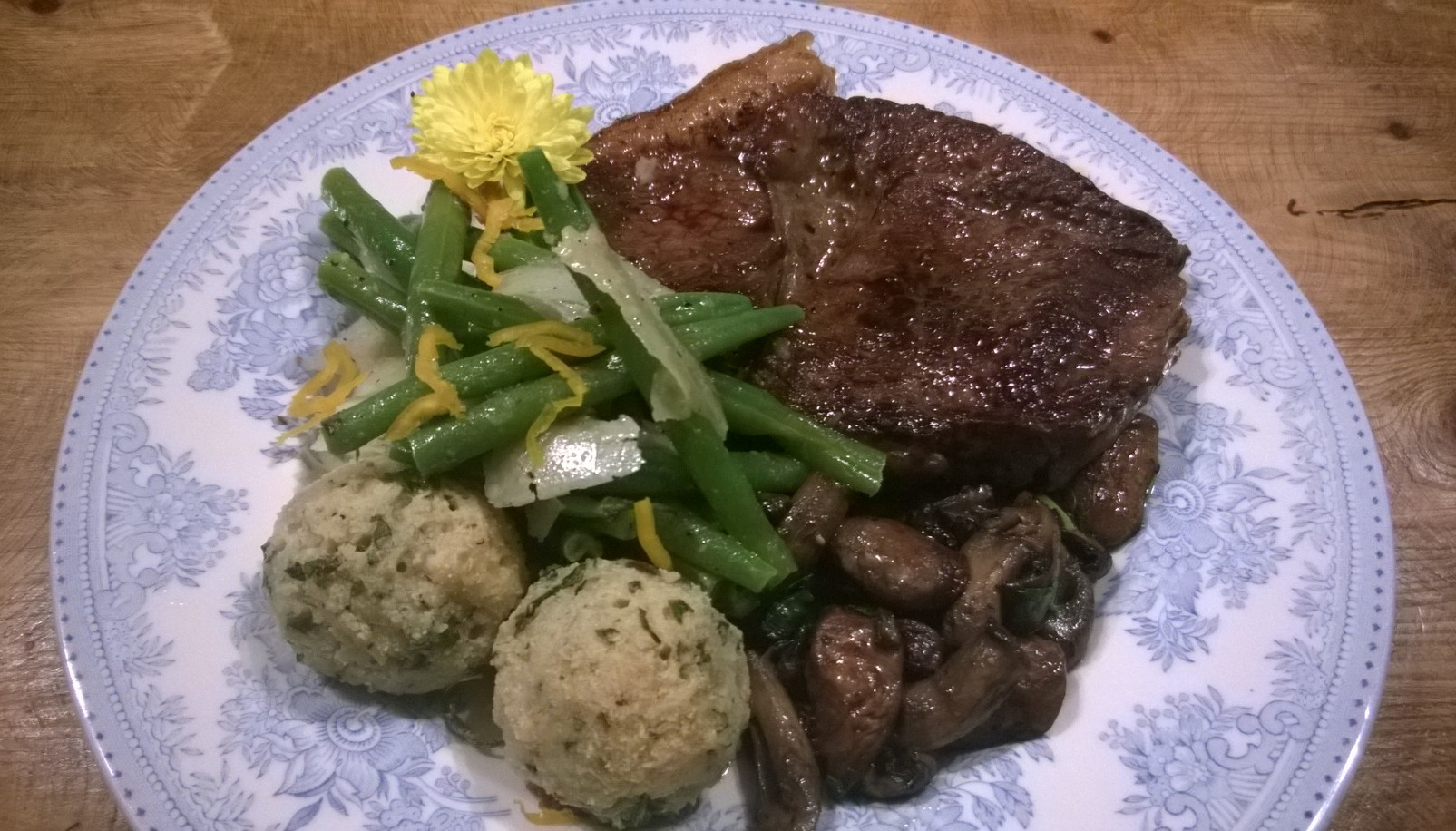
Seared Rump-Steak with Herby Suet-Dumplings, Garlic Mushrooms & Dressed Parmesan French-Beans… Classically low-carb, supremely satisfying & effortlessly easy!

steak

The beauty of steak lies in two things: its taste and its simplicity. Like many things in life; you get what you pay for! So I’d always rather have steak less frequently, but of higher quality.

Here, I team it with something you wouldn’t necessarily associate with low-carb eating: suet dumplings! These are made with almonds instead of flour; so present no problems to the gluten-free-, ketogenic- or diabetic-diner. The garlic mushrooms and dressed beans are a personal homage to French classicism. One thing the French do really well is vegetables, and I take my hat off to them for this combo!

Start with the dumplings. These work on the classic ‘half fat to flour’ ratio. Take 6oz of ground almonds and 3oz of beef suet to make 4 medium-sized dumplings (midway between golf-ball and tennis-ball – does that equal hockey-ball??? No idea). Make sure you check the packet if you’ve bought your suet from a supermarket. Some suets contain large amounts of flour to stop the grains from sticking together. Mix together in a bowl, add chopped herbs, salt and pepper, plus a pinch of bicarbonate-of-soda. Slowly add cold water, dribble-by-dribble; until the mix clumps together. If you use a dinner-knife to mix the water in, then you’ll see far more easily when the mix is cohesive enough to form a dough. A spoon tends to ‘smear’ and ‘spread’. A knife mixes neatly.

Form the dough into balls then steam over water for 5 minutes in a pan with a heavy lid. There may be some disintegration into the water, but that’s only natural. Transfer the dumplings to the oven and bake for 15 minutes until crisp on the outside.

While these are in the oven, heat your skillet-pan to a good searing heat. Throw in a little butter, then add your seasoned steak; enjoying the sizzle as it hits the pan. Turn after a couple of minutes and re-season the upturned cooked-side.

Chop some mushrooms and add these to the pan. Melt in a good spoonful of garlic butter, then rub what is left on the spoon onto the surface of the steak. For this quantity of garlic-butter, think one small clove of crushed garlic, to one large table-spoon of butter. Much more garlic and it acquires a ‘burn’. Remove the steak from the pan to rest, and continue to cook the mushrooms.

In the water used to steam the dumplings, steam your beans for 2 minutes until they’re cooked, but still have their bite. Season, dress with vinaigrette, then shave fresh parmesan-cheese over the lot.

Take the dumplings out of the oven and serve next to the steak. Spoon out your mushrooms, and pour a little of the buttery pan-juices over the steak and dumplings. Dish up the beans, help yourself to a spoonful of mild Dijon mustard; then head straight to the table whilst the whole thing is still piping hot!

The simple pleasures in life are always the best!

Thanks for reading and bon ap!

Adam.

Sugar-Cravings on a Low-Carb Diet – can you do LCHF with a sweet-tooth…?

A reader emailed me to say that she was keen to try a ketogenic-diet, but that she’d always suffered from sugar-cravings.

Despite past attempts at Atkins, low-GI and a paleo-regime; these cravings had always got the better of her and led to disappointing failure in the end.

I thought I’d take this opportunity to share my own experiences with sugar-cravings, in the hope it may be of help to this one reader, and others like her…

Before I go any further, I’m going to state a fact that I’ve hitherto not divulged on this blog… I work in the product-development team of a chocolate factory! I’m surrounded by the stuff night and day. Do I snack? No. When I was on a traditional low-fat diet, did I snack? Yes. It’s the ketogenic-diet which has has enabled me for the first time to resist temptation and pass up sweets, chocolates & confectionery in all its forms.

No; I don’t wear a muzzle or clamp my hands behind my back; rather I just have no desire or hunger-pangs to lead me to cheat. Once you’ve broken the glucose-cycle, you’re freed from all the gnawing cravings which lead you to break the diet and pile the pounds back on again.

Does this mean I’m not eating anything sweet? No it does not. I too have a particularly sweet-tooth; but now I’m eating LCHF puddings which don’t contain glucose. I can enjoy home-made cakes, biscuits and desserts with no fear of spiralling blood-sugar levels. I’ve put hyperlinks to a few examples below, so you can see the kind of thing I’m referring to.

Tira-Misu Cake

Orange, Coconut, Lime & Almond Cake

Chocolate mousse with Biscotti

So, how does this work? How can you eat this kind of food and lose weight? The answer lies in the fact there’s no glucose.

Glucose is the body’s ‘quick fix’ to energy and gives us a pleasing blood-sugar rush. But once insulin has cleared the glucose away, the brain goes into ‘panic-mode’ and thinks that the falling glucose-levels means a drop in energy-levels. Your brain then sends messages ‘quick you need sugar!’ and you crave (then eat) something sweet. A roller-coaster ride of high blood-sugar, then dramatic sugar-crashes ensues; leaving you constantly snacking and gaining weight.

Glucose drives you to eat to when your sugar-levels drop; it has nothing to do with how much you’ve eaten or whether you need food.

To break this sugar-cycle, all you need do is remove glucose from your diet. I again insert a couple of hyperlinks to posts which explain this in a little more detail.

The Role of Insulin

Fuel v Energy

What Is Ketosis?

So, I wean myself off glucose. How is it that I eat sweet things?

There are many different forms of sweetener and flour substitutes. Ground-almonds and xylitol are by far the best. Xylitol is 100% natural, has zero net carbs, and doesn’t lose its sweetness in cooking (most sweeteners lose their sweet-flavour above circa 100º). This combination of low-carb / high-performance means that you’ll be consuming sweet things which don’t trigger the glucose-cycle. Once you’ve eaten, you’ll feel full and won’t keep returning to snack.

I can’t pretend to you there’s a barrage of convenience LCHF snacks out there, because there isn’t. You’ll be spending more time in the kitchen if you want something sweet; but isn’t that the best way? By the time it’s ready, you’ll have earned it & appreciate it more! Sugar-free jelly can give you that ‘Haribo’ taste, and cocoa chocolate-mousse takes all of two minutes to prepare (see recipe 3).

So that’s what to eat and why it won’t induce cravings; but there’s one extra thing to throw into the equation… Saturated fat!

Because fat is far slower to metabolise than glucose, it slows down digestion when it enters the intestinal-tract. When you’re busy digesting, your brain knows that you’re full, and your appetite is decreased.

You cannot avoid fat when doing this diet. If anything; the opposite! The fat makes you feel full; so full in fact, that you’ll not be snacking AT ALL (be it sweet or savoury). Again, I return to my chocolate-factory reference above – I’m surrounded by the stuff all day at work, and don’t get a single craving. In all honesty; I’m too full! I often can’t believe when it’s lunchtime, because my body is giving me NO SIGNALS AT ALL that it’s time to eat!

A fat-metabolism prompts you to eat when you’re hungry, then stop when you’re full.

Because of this increased sense of satiety, and the huge reduction in volume of food-consumed; you’ll immediately find that sugar-cravings and snacking are a thing of the past. Take it from someone who knows!

And lastly but not leastly; weighing things out. Am I constantly weighing my food before I eat it? Never. I simply stick to the things I know I can have, and ignore the things I can’t. I hope you’ll agree that our diet is really quite varied…

I hyperlink a list of vegetables as a starter for ten. The New Atkins UK site has some brilliant tools, including the carb-calculator!

Ketogenic Vegetables Shopping List

If something in the supermarket is an unknown, then I just read the label. After a couple of shops, that’s about one thing in fifty! Make sure you take into account the ‘net carbs rule’ – I link to this below:

Calculating Net Carbs 

Hopefully the above should go a little way towards calming your concerns over cravings… Please do ask questions if I can be of any help along the way.

Good luck with the ketogenic-diet and thanks for reading!

Adam.

Orange, Coconut, Lime & Almond Cake with Zesty Cream-Cheese Frosting – you’d never it know it’s low-carb! Nor would your blood-sugar!

cake 2

A lot of low-carb baking recipes feel very much the poor relative of their high-glucose cousins. You often feel that you’re eating a sterile ‘copy’, which doesn’t do justice to the original, & is tinged throughout with disappointment. No so with these!

I cannot advocate this recipe enough! The citrus zing is just what the doctor ordered on a gloomy autumn day. The density of the ground-almonds & coconut lends the cake that really ‘substantial’ feeling – exactly where most flour-free cakes fall short of the mark!

It’s difficult getting as far as applying the icing – the urge to dig in whilst they’re still warm is almost overpowering! The same goes for the frosting itself… One taste will never be enough to check the flavour!

Because the cake is incredibly low in carbohydrate, it’s perfect for diabetics, paleo-fans, gluten-intolerants and those on a ketogenic-diet. It’s truly astounding that you can eat this and lose weight. Pinch me…!

To make the cake, weigh up 6oz of ground-almonds and 4oz of dessicated coconut. Add to a sturdy mixing-bowl and stir in 1 teaspoon of bicarbonate of soda, plus the same of flaxseed.

Measure 3oz of xylitol sweetener and combine this with the almond-mixture. I always use xylitol in baking. In my experience, it’s the only sweetener which retains its sweetness once cooked; and its granular texture means that it behaves exactly like sugar in cake-recipes.

Set 2 large tablespoons of coconut-oil to melt by the range; or microwave it until liquid. Finely grate the zest of 1 large orange and add both this and the coconut-oil to the mixing-bowl. Finally, stir in 3 beaten eggs, the juice of one lime, and fold until you have an easy-to-please dropping-consistency.

Spoon the cake-mix into your cake-tins. I used small, individual squares, but this can equally go into one larger tin; round or square to your preference. Bake in a moderate oven for circa 30 minutes, until risen, golden but not too brown. The cakes should be spongy and resistant to the touch, and rise back up when pressed lightly with the finger. Remove from the oven and cool until room-temperature.

Once the cake is thoroughly cooled (and yes; it needs to be, or your icing will melt everywhere); place 4 large tablespoons of mascapone into a bowl. Add half a cup full of table-sweetener (this can be other than xylitol, because it’s uncooked) and the zest of an orange. Fold through with a knife until the zest is pleasingly dispersed into the mixture. Make sure not to over-mix or it will go runny. Test for sweetness, adjusting zest or sweetener levels to your preference.

Layer the frosting generously atop the cakes with a palette-knife. This is not a time to scrimp! Sprinkle with more grated zest and lightly toasted almonds to decorate.

You know what to do next!

Thanks for reading & bon ap!

Adam.

Week 5 – Sun 2nd November

Well, I’m five weeks in now. Just to remind you all, I started the ketogenic diet at 15 stone, 10 pounds. My goal is 12 and a half stone, by mid-March 2015. This means a target weight-loss of 2lb per week.

Week Five’s target-weight therefore? 15 stone, 0 pounds. Waistline measurement only once a month, so not this week.

I step onto the scales…

14 stone, 13 pounds. Ahead of target and a 2lb reduction from last week! I’m now 11 pounds lighter than I was five weeks ago. I’ve crossed the ’15-stone barrier’ & am now comfortably back in the ’14 stone something’ territory.  If feels brilliant!

It’s been a strange week for ‘weight’. The scales really do vary; as does self-perception. The more weight one starts to lose, the more one looks at oneself and is critical of the remaining fat. I suppose that’s what spurs one on to carry on losing it.

I must admit that I’m starting to feel a little impatient now… Not that the diet is simply a weight-loss thing, to be dropped when the weight is gone; but I want results and I want them now!! It all makes me feel like a petulant child. I suppose I just want to fast-track all the anxiety of ‘have I lost anything…?, when can I go and buy new clothes…?‘ &tc. Well, I suppose I shouldn’t be such a spoilt brat! I’m ahead of target and shifting body-fat fast! So all in all I’m very pleased. I can be forgiven a little impatience, can I not…?

Nicholas James has also lost a stone, which is really good going. His blood-sugars are super-stable and he feels fighting fit and full of energy! Positives all round therefore.

And physically? How am I feeling aside from the weight?

Pretty good. I feel increasingly active and want to get moving. I still feel too heavy to jog; the bouncing up and down of michelin-man-style tyres would be a little depressing (and uncomfortable!). I expect I’ll need to get down to somewhere in the region of 14 stone before jogging is back on the cards.

I’m still thirsty a lot but I’ve got used to it now. Peppermint-tea throughout the day helps with the paranoia of acetone on the breath – a side-effect of ketosis. I think this might be on the wane, but I’m not going to take any chances! I’m hoping that, as ketogenic-adaptation kicks in (more on that in another post); this side-effect will disappear completely. Only time will tell.

All in all, it’s been a good week. I’m pleased with the results and so glad to be back in the ’14-bracket’. My next target is to dip below 14 stone, 10lb; which’ll mean I’ve lost a full stone. I doubt that will be next week, as it’s a further 3lbs but I’ll give it a go!

I’m well on the way to being a new slimmer, fitter me, and there’s no looking back. Please do ‘look in’ on me next week however, to see if I meet my targets. I find it really positive to have people read this – the support is a massive encouragement!

Thanks for reading, and have a great week,

Adam.

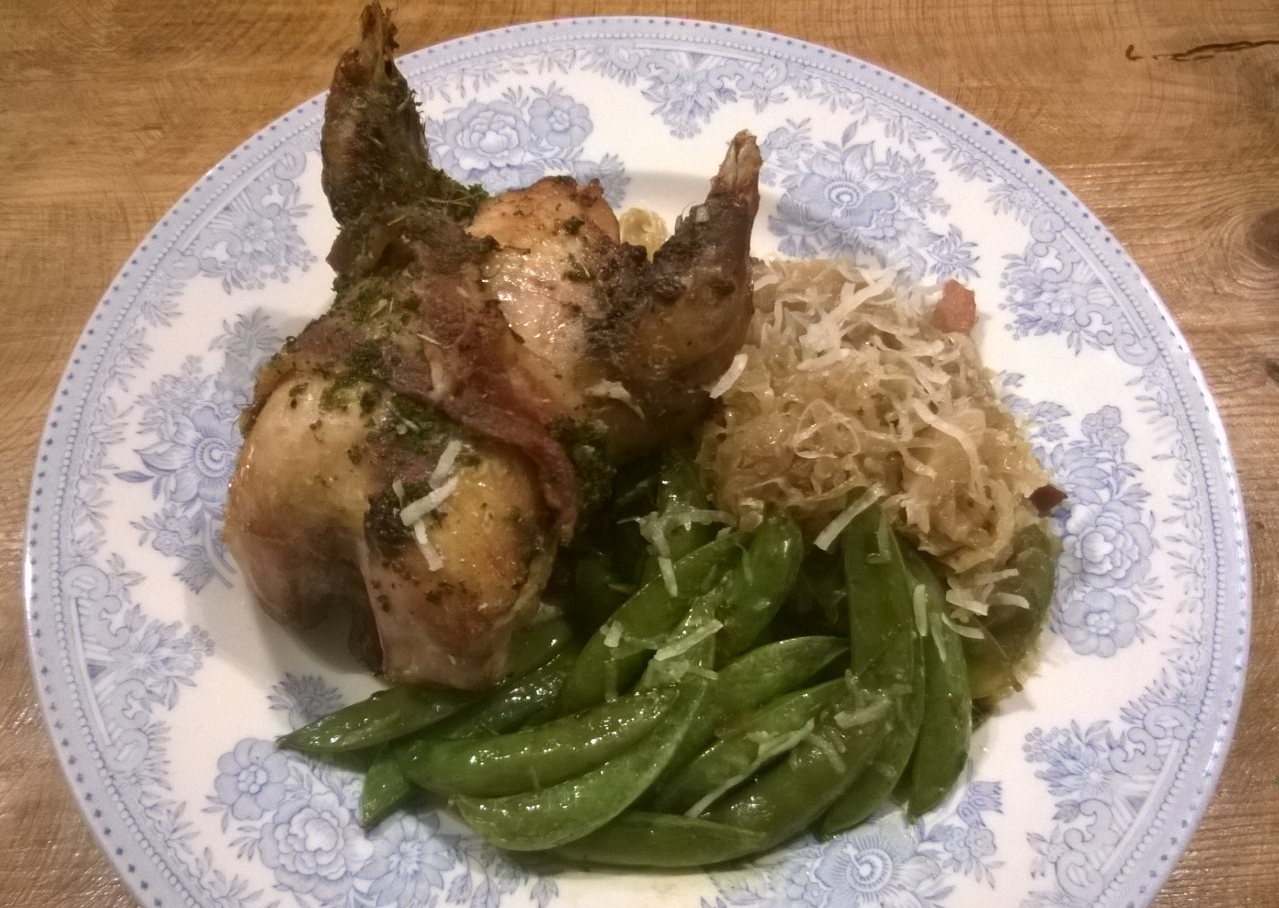
Sage-Roasted Partridge with Buttered Bacon Sauerkraut & Pea-Pods. Stock the game-larder as shooting-season begins! Nature’s low-carb harvest.

partridge

Autumn sees the start of the English shooting-season. Few things could be finer or more quintessentially English, than the sight of ‘the guns’ returning; flushed with pride & resplendently decked with braces of partridge & pheasant. This is British cooking at its best.

Though the guns may be in top form; the game-birds still require a little longer to reach their peak. A few more weeks of feasting on autumn’s ripe harvest should give them that all important layer of fat which ensures succulence & flavour. Always therefore pick game with the heaviest marbling of fat. It will pay off in the eating!

For such a traditional thing, you may be surprised that I’ve chosen a German accompaniment – sauerkraut. The match is one made in heaven! The slight astringency of the wine-pickled cabbage, compliments the rich heady taste of game wonderfully. All you need is a good dollop of English mustard and you’re good to go!

Start with the sauerkraut. Sauté smoked-bacon pieces / lardons in a heavy-bottomed pan. Once brown, add a little butter, onion and garlic. Cook until the onions start to brown then add your drained, rinsed pickled-cabbage. Try to go for a type that’s been steeped in white wine and vinegar; the flavour is better.

ALWAYS rinse pickled cabbage, whether from packet, jar or can. If not, the flavour will be vinegary and unpleasant. That’s the quality that puts many people off. When it’s done properly it truly is a culinary inspiration!

You want to make sure the cabbage carries quite a lot of water from ‘the rinsing’ as it goes into the pan. This will prevent the dish from drying out. Crumble on a couple of chicken stock-cubes, season, then place the lid on the pan. Simmer on a very low heat for approximately an hour, checking periodically that the mix still has sufficient liquid to steam & not dry out.

Meanwhile, wrap your partridge in streaky-bacon and place a little sage-butter in the cavity (sage-butter? literally as it sounds). Season well, making sure that the skin has sufficient salt to crisp. Sprinkle with a final dusting of sage then place BREAST-SIDE-DOWN in a roasting dish. Then into a hot oven.

Why breast-side-down? The butter, and what little fat there is on the carcass; will melt and diffuse into the breast-meat, preventing dryness. Roast for 20 minutes until browned, then turn over in the tray. Re-season the breast-side then bake for a further 20 minutes until golden. Take out of the oven, cover in foil and leave to rest for 15 minutes or so, retaining the juices in the pan.

Place your green vegetables into the pan which held the partridge. Toss in the juices to coat, then oven-roast for 10 minutes until they’re cooked-through but still have bite. Now check the cabbage for seasoning and stir in a knob of butter.

Plate up the partridge and serve a generous spoonful of sauerkraut on the side. Dish up your vegetables and grate a small amount of parmesan on top for added richness.

This recipe really warms the cockles of the heart. Comfort-food doesn’t get more classic than this! And all without carbs.

Thanks for reading and bon ap!

Adam.

Zero-Carb Crackers! Truly a food revelation. The joy of the cheeseboard is back! Try them as a starter with dip, pâté or salads. The choice is all yours!

crackers

One of the added bonuses of a ketogenic, low-carb diet; is that it forces one out of one’s comfort-zone to try something new.

I’ve always been quite traditional in the kitchen, so I was really not sure how I’d feel about these zero-carb crackers. Firstly, they’re cooked in the microwave, which the food-snob in me abhors! Secondly, the ingredients-list hardly sounds appealing… Flax-seed, water and dried-herbs (yes, I know).

I took the basis for this recipe from the New Atkins UK website. I almost couldn’t bring myself to try it; but the cook in me was intrigued…the recipe sounded such a strange thing. But guess what? I tried them and they’re brilliant! 

Whilst cheese has always been on the ketogenic-menu; the cheese-board rather lacked something with a bit of bite. Sure; you can have celery; but it’s no real replacement for crackers. But now you don’t need one!

I really urge you to give these a go. If I can do them, then anyone can! They’e perfect for diabetics too, as they have no impact on blood-sugar. Everyone can always use a bit more fibre in their diet, and what could be a better source of fibre than flaxseed?! So go ahead and try them. Make sure to get back to me to let me know how you got on…

Take four tablespoons of flaxseed and a good pinch of salt. Sprinkle in some dried herbs; I used sage because of its warmth of flavour, but thyme would also be lovely. Grind in a generous whack of black-pepper, then slowly mix in cold water until the ingredients come together to form a cohesive paste. This will probably be about 60ml.

Leave for five minutes to bind, then spread flat onto non-stick baking-paper with the back of a spoon. Neaten the edges, then microwave full power for circa 2.5 minutes, until the crackers are solid and crisp-feeling to the touch. Sprinkle with a final pinch of salt and serve alongside your cheese.

For variation, try adding a pinch of dried-ginger or cumin. The above quantities should make 6 generous crackers, depending on size.

You’d never know these were low-carb! They also work brilliantly as an accompaniment to starters (picture pâté, mackerel or a selection of dips). Because of this, I’ve included this recipe in the ‘starters’ section, as well as ‘puddings’ for the cheese-board.

Thanks for reading and bon ap!

Adam.

Country Walks in Ketosis – Now on Facebook!

Country Walks in Ketosis now has its very own facebook page…

facebook.com/countrywalksinketosis

I think this must mean that my computer skills are improving! I’m beginning to feel very modern…

If you’re enjoying any of what you’ve read, please ‘like’ the facebook page & spread the word.

Thanks for your support,

Adam.

Quick navigation tabs now added to effortlessly browse recipes and posts!

Recipes have now been categorised under starters, mains and puddings.

Nutrition, diet and diabetes info have been itemised under a separate tab for ease of reference – The Low Carb Library!

Amble through country-walks and lifestyle posts via quick, user-friendly drop-downs.

Thanks for reading and your ongoing support.

Adam.

banner

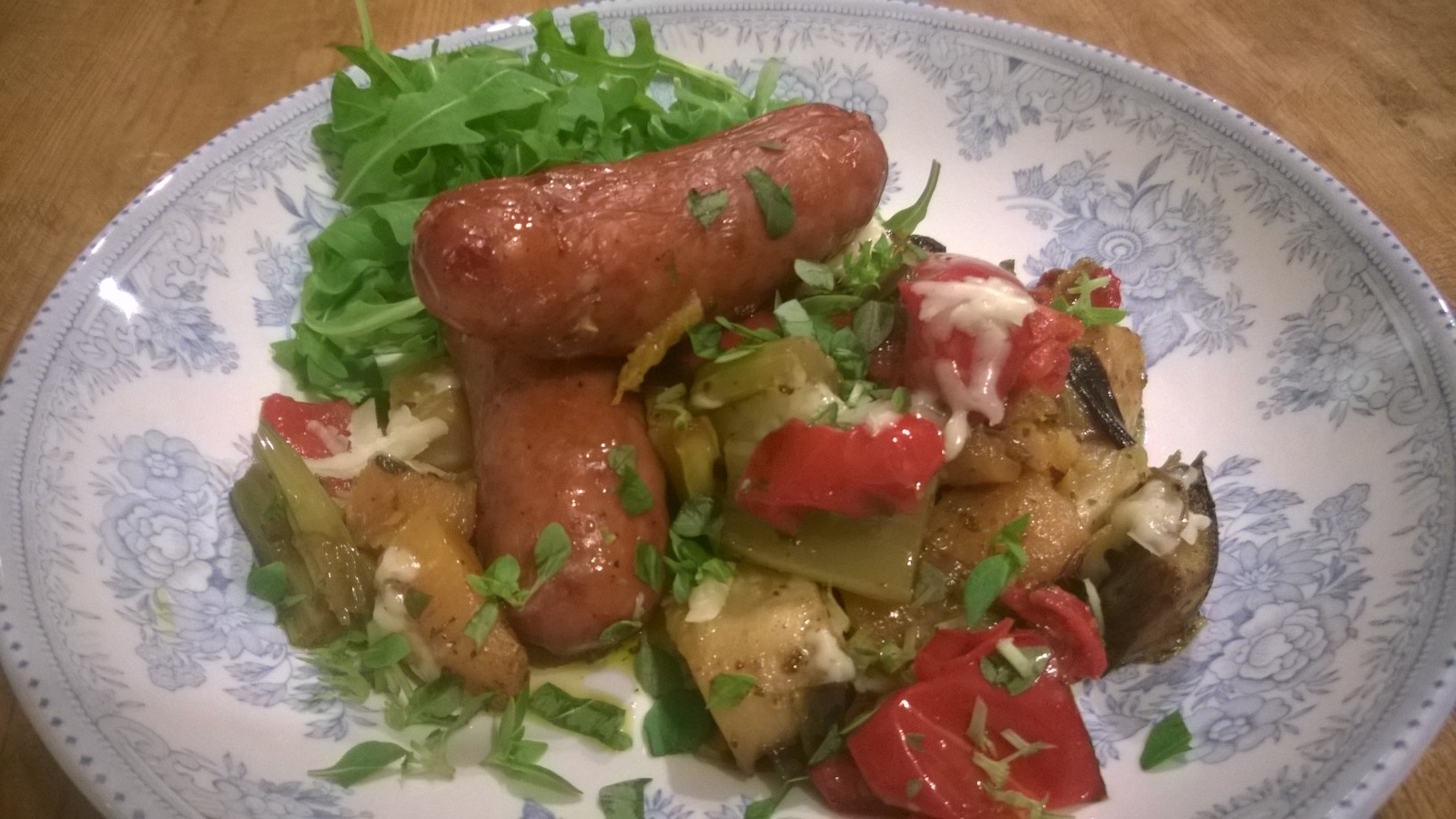
Silesian Sokolow with Pumpkin, Celeriac & Cumin-Roasted Vegetables – a low-carb autumn treat; simple, delicious & bursting with flavour!

polish sausage

Because it’s Halloween, I naturally couldn’t resist cooking something with pumpkin. But this dish is a winner on any day of the year!

Sokolow is one of those sausages with such intensity of flavour that complex cooking will only serve to clutter it. The rich, spicy, salty tang, & course-ground filling are best left enjoyed just as they are. Any accompaniment will require depth of flavour that holds its own, but doesn’t compete.  That’s why I chose cumin – it has a warmth which compliments the sausages perfectly; so perfectly that there won’t be a scrap left on the plate!

This is one of those great ‘oven-only’ meals. Once prepared, you can just leave it in the oven and slowly start to relax into your evening. For this reason, it’s a wonderful thing to have up your sleeve on a week-night. And at this time of year, few things could be more satisfying than chunks of roast pumpkin and spiced pork. You’d never know it’s low carb! As such, it’s one of those ketogenic- / diabetic treats that’s really substantial & filling. So go on & enjoy…! We certainly did!

Dice your pumpkin, along with any other low-carb vegetables you have to hand. I used celeriac, celery, onion, peppers, leek & a few spring-onions I had left over. Pumpkin is higher in carbohydrate than the other vegetables; so make sure it only comprises about a quarter of the vegetables by volume. Sprinkle on a generous shake of ground-cumin, paprika, salt, pepper & crushed garlic, then pour on a good glug of olive oil. Mix with your hands to ensure that everything’s well coated.

Roast in a hot oven for 40 minutes, or until there is a slight browning around the edges of the vegetables. At this point, add your sausages on top, and cook for a further 20 minutes.

Et voila! It’s that simple… Serve with a small sprinkle of grated cheese and some freshly chopped herbs. Once you’ve made this, it will become a firm favourite in your repertoire. You’ll want to cook it time and time again. And at this low level of carbs, you can do just that!

Thanks for reading and bon ap!

Adam.

Fiery Witches’ Cauldrons… Serve up a creepy low-carb scare this Halloween!

cauldrons real

A bit of fun for Halloween night! If you’re having friends over for a drink, then this is the perfect way to serve up a few demonic dips and creepy crudités…

Hollow out cooked beetroot with a melon-baller. Remember; if you’re on a ketogenic-diet then the beetroot is just for decoration. Beetroot is fairly heavy on the carbs, so is best consumed with restraint.

Fill the hollowed-out cauldrons with a selection of your favourite dips. I’ve chosen Middle-Eastern Baba Ganoush, topped with pesto, it’s very low in carbohydrate and won’t impact your blood-sugar. Recipe follows below…

Arrange the beetroot-cauldrons on a bed of sprouting-broccoli and frankfurter sausages, placing upright chantenay carrots at internals to serve as ‘flames’. The carrots too are only for decoration if you’re in the weight-loss phase of a diet. Diabetics, or those with a higher carbohydrate-allowance can dig in with gusto!

Devilishly delicious and incredibly easy. The perfect start to an evening of terrible treats!

To make the baba ganoush, prick circa 3 aubergines with a fork and grill, until the skin is charred and the flesh beneath feels soft to the touch. As a guide, this takes around 20 minutes. Make sure to turn them periodically, so that they don’t over-cook on any one side.

Blitz x2 large cloves of garlic in a food-processor, then add the juice of one lemon, a teaspoon of tahini, olive oil, ground cumin and a generous whack of flat-leafed parsley. When this is smooth add your aubergine.

Slice the aubergines down the middle and scoop out the flesh into the food-processor. Pulse the mix, until you reach your desired texture. I like it nice and smooth, but you may prefer a chunkier texture. If so, just pulse it a little less.

A brilliant accompaniment to dip is celery-sticks, smoked sausages, crisp lettuce-leaves, radishes, purple-sprouting broccoli or even raw cauliflower.

This also works as a starter, serving one cauldron per person.

Thanks for reading, happy Halloween and bon ap!

Adam.

Halloween Special – From the low-carb cauldron! Musings on a witch’s waistline…

pump

    Double, double toil and trouble;
    Fire burn, and caldron bubble.
    Fillet of a fenny snake,
    In the caldron boil and bake;
    Eye of newt, and toe of frog,
    Wool of bat, and tongue of dog,
    Adder’s fork, and blind-worm’s sting,
    Lizard’s leg, and owlet’s wing,—
    For a charm of powerful trouble,
    Like a hell-broth boil and bubble.

Shakespeare’s famous witches scene from Macbeth reinforces what many of us have always known… Witches were very low-carb eaters…

Irrefutable evidence from a number of late-medieval manuscripts, corroborates what fictional sources such as Macbeth have always confirmed. Shakespeare actually lifted the above recipe straight from the period’s most popular ketogenic cookbook: ‘The Low-Carb Cauldron’.

Ingredients such as newts’ eyes and fenny snake were highly prized for their omega 3 and rich saturate density. Bat-wool provided an excellent source of non-soluble dietary-fibre, which slowed down digestion in the gut, thereby promoting feelings of satiety and quelling hunger-pangs.

In fact, depictions of the classic witch’s wand are actually a primitive form of keto-stick. Their frequent testing of urine-samples served only to heighten the existing suspicion and contempt, held against them by an increasingly obese society of glucose-intolerants.

In the end, it was that society’s jealousy over how witches stayed so ‘magically slim’ that led to their vilification and gave rise to the notorious witch-hunts which so plagued the middle-ages.

So ‘witch’ diet will you follow today…? My money’s on LCHF!

Thanks for reading and Happy Halloween!

Adam.

Earthy & Aromatic Spanish Chicken with Chorizo, Aubergine & Buttered Savoy. A bowlful of low-carb comfort!

spanish chicken

The earthy flavours of chorizo and cumin are just the thing when the dark evenings start to draw in. They’re very much a staple in our household. I’m often late home from work, and crave something that’s simple, yet tastes anything but!

The depth of flavour in this dish lends the impression it’s been cooking for hours. But because you can just leave it in the oven, it won’t take up a fraction of your time. As there are no carbs, diabetics & ketogenic-dieters can dig in without qualms. And believe me – they will!

Season the chicken-skins and sprinkle with herbs. Roast in a hot oven for circa 45 mins to an hour, or until the chicken-pieces are golden and crisp.

Meanwhile heat some olive oil in a pan and sauté some chopped, cooking-chorizo. Add onion, garlic, mushrooms & diced aubergine, then cook on a medium heat until soft. Sprinkle on turmeric, paprika & dried thyme, then de-glaze the pan with dry sherry or white wine. If you have any orange-flower water, it adds a nice fragrant edge; a cap-full should be fine. Pour on some water, until the mix is up to its ears in liquid. Crumble in chicken stock-cubes then reduce down to a third of the liquid’s volume. Add chopped olives & check for seasoning.

Finely chop your savoy-cabbage, rinse, then add to a pan with the water still clinging to it. Throw in some butter and salt, then cook with the lid on for 5 minutes until tender. Serve up alongside the chicken in big bowls, then spoon the sauce all over the top. Autumnal perfection itself!

Enjoy and thanks for reading. Bon ap!

Adam.

The pros & cons of pounds & ounces. Or… Weighing up ‘weighing in’…

Should we ‘scale down’ the weighing-scales? This is a difficult question; and one I feel should very much be a matter of personal preference.

At the start of this process, I vowed to myself that I’d never become a ‘weighing-scales’ addict. I wouldn’t measure too often, or obsess about the latest reading. Instead, I’d take a ‘measured’ approach and trust more in the fit of my clothes and other markers. These include energy-levels, general well-being, as well as the ultimate indicator – the mirror!

Without monitoring progress however, how would I assess whether or not I was on track to meet my targets?

This conundrum led me to the decision to ‘weigh in’ once a week. This interval would allow me to keep a healthy distance from data. Hopefully I’d just crest along smoothly, and get a nice surprise once a week.

And then it all went wrong.

Week 2 saw the worst thing a dieter can experience – gaining weight, rather than losing it! This was really distressing. I’d tried so hard and had been in ketosis the whole time. I simply couldn’t understand the fluctuation. I consequently mulled it over for a while & managed to identify the problem. I changed my diet accordingly and succeeded in bringing things back on track.

A week is a long time to wait for diet-disappointment. Would this trend have been spotted earlier if I’d have ‘weighed in’ more often? I think it would.

I must admit to having stepped onto the scales most mornings since then. Yes; there’s inevitably the daily confusion of ‘how on earth has that happened?’; but a more frequent benchmark enables me to spot any problems and address them as soon as they occur.

My ‘corrective action’ may be as simple as having a smaller portion for dinner, or taking a little bit more exercise than planned. So far, this seems to be working.

And after all; if I hadn’t avoided the scales for so long prior to now; I probably would never have gained so much weight in the first place!

So for many, the jury’s still out on the weighing-scales. For me however, I’m a convert. It takes a lot of time, effort, planning & money to initiate a lifestyle-change to this extent. I really want it to work. Why risk all that for no reason?

There’s an old saying which states ‘you don’t fatten a pig by weighing it all the time’. Well, I think the opposite is true if you’re trying to slim it down!

For the time being then, I’m keeping the scales and shall heed their advice. Maybe at the end of all this, I’ll have a ceremonial purge and rid myself of them forever.

Or maybe I won’t. Who knows? Ask me when I’m there.

Thanks for reading,

Adam.

Testing for ketones…

One of the things I really like about this diet, is the ability to check that your food-choices are having the desired effect.

What do I mean? If you’re in ketosis, then you’re definitely burning body-fat!

Other diets don’t have this security-blanket. On a low-fat diet, you only have the scales to rely upon. And these fluctuate daily, with sufficient variation to make even the most rational person more than a little paranoid about their progress…

So how do you test for ketones?

There are two methods currently available on the market:

  • Ketone testing-strips e.g. Ketostix. These test ketones excreted in the urine
  • Ketone blood-testing meters e.g. Freestyle Optimum. These test ketone-levels in the blood.

There’s naturally a huge difference in price between the two. So which is better?

Ketone-strips are a cheap and cheerful method (my diabetic partner & I both use them currently). You place a single strip into the urine-stream and after 15 seconds, the colour changes to indicate ketone-levels . It shows a gradation of weak > strong; and you match the colour of the strip against that scale (indicated on the side of the packaging).

ketostix

A ketone-level somewhere between 1.5 – 3 is said to be the optimal level for maximizing weight-loss.

Pros & cons? Well; I’m colour-blind, which makes things rather difficult!!; but I can still detect the stronger intensities, so it’s pretty functional on a day-to-day level.

What it’s important to realise, is that ketones excreted in urine are only ‘excess’ ketones, not metabolised by the body (i.e. the excess energy you haven’t burnt, which would otherwise have been stored as fat on a glucose diet). The strips don’t therefore indicate actual levels in the body. There’s inevitably a time-lag too, as the strips will be indicating levels from several hours ago (urine being the end-point of a process).

It spite of this, they’re more than good enough for me at present. They say that ketone-levels decrease in urine after a few months of nutritional-ketosis; so if they cease to become effective, then I’ll reassess as need dictates.

And the meters? These are obviously a lot fancier. The readings are ‘measurable’, accurate and current! They show the actual levels in the blood at any given time, plus a precise reading (as opposed to a rough guess based on a colour-scale).

The accuracy is the main advantage. Ketones in urine show the ‘past excess’; they can’t show the ‘current totals’. The monitors are therefore far better if you require this level of accuracy. The downside? Cost.

Whichever version you choose, being able to monitor ketones provides you with a tool to make dietary-adjustments where necessary. If you see that ketones are getting weaker, you can lower your carb-intake accordingly. This makes the whole thing far easier to manage – you don’t have to wait until you’ve gained weight to realise that something’s wrong!

So happy testing!

Thanks for reading,

Adam.

Fifty shades ‘beyond’ grey…

grey day

It’s a drizzly, overcast day in the state of ketosis. In spite of that, the world is still bright and bursting with colour!

Take a look for yourself…!

red cabbage

white flower

green leaves

purple cabbage

yellow mushroom

tie

Thanks for reading and enjoy the day!

Adam.

Crispy Thai Coconut Pork with Butternut Noodles – low carb, diabetic & delicious!

pork nood

I’ve recently discovered the wonder of zoodles, and I must confess; I’m hooked! These ones are made with butternut-squash. They’re a little bit higher in carbs than their courgette counterparts; but certainly nothing to worry about. If you’re still in the weight-loss phase of a ketogenic diet, then just don’t have seconds. Everyone else (including diabetics), can pile them up and get stuck in!

Pork belly slices are one of our favourites. Cooked for long enough, they go beautifully crisp on the outside, yet stay gooey and unctuous in the middle. They’re also easy to cook, as they don’t need turning or ‘fussing over’. They can simply go straight in the oven until they’re done.

Start by cutting your pork-belly slices into inch chunks. In a mixing-bowl, prepare a dry-rub of garlic-salt, paprika, dried thyme, salt, pepper, cumin and ground coriander-seed. Place the pork into the mixing-bowl and massage the spice-mix into the meat. Place on a lined baking-tray & oven for circa our hour until crisp.

Meanwhile peel your squash and cut the ‘zoodles’ with a julienne-peeler or equivalent machine. Sauté in butter and olive oil until they lose their rawness, yet still retain bite (circa 20 mins). Season well, then remove from the heat.

Finely dice an onion, garlic and chilli. Cook until soft, then crank up the heat and pour in a good cupful of water. Follow this with a couple of stock cubes, a squeeze of lime, and chopped coriander stalks. Let the mix reduce to half its volume, then add a half can of coconut milk (full fat) and cook until the sauce has thickened. I also added thinly sliced cabbage and mange-tout to the sauce, just after adding the coconut; but these additions are naturally to preference.

Reheat your squash-noodles in the pan for a couple of minutes. Pour on the vegetably coconut sauce, then scatter your pork-belly slices over the top. Garnish with plenty of chopped coriander and serve to the hoards!

Thanks for reading and bon ap!

Adam.