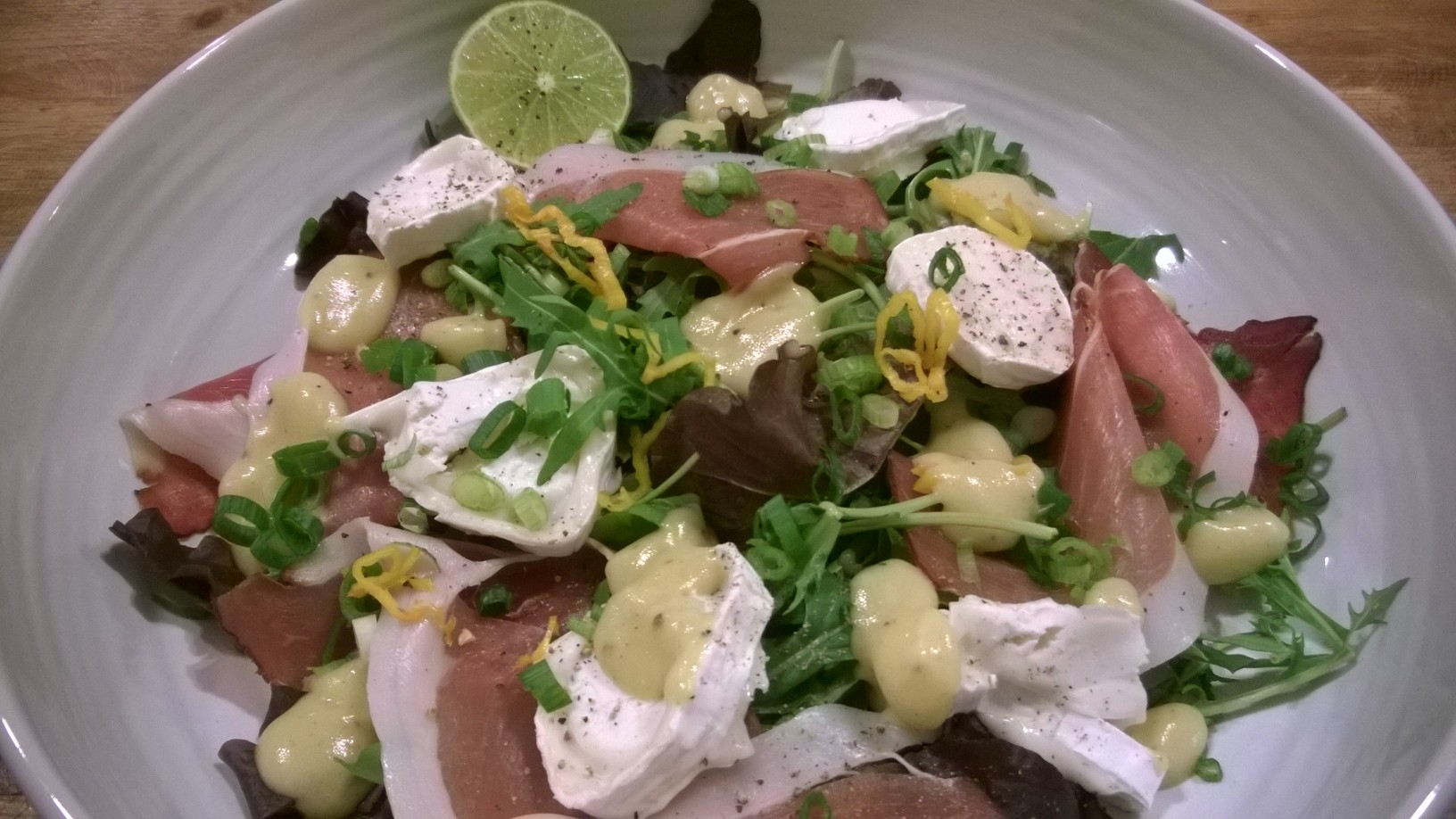
Goat’s Cheese, Parma Ham & Rocket Salad – low carb fast food that’s bursting with flavour!

parma ham and goats' cheese salad


Good food needn’t be complicated or fiddly. Take this salad for example; it’s absolutely delicious and prepared in minutes!

The slightly soured taste of goat’s cheese perfectly balances the deep, full flavour of smoky parma ham. Both ingredients are lifted by the bright ‘tang’ of vinaigrette, which cuts through the richness and refreshes the palette.

I’ve also added some finely sliced scotch-bonnet chilli to give the whole thing a polite background kick! This is naturally up to you entirely. The dish is equally delicious without it!

Place your rocket and mixed leaves into the base of your salad-bowl. Layer on slices or parma ham and rondelles of goat’s cheese.

Finely chop a spring onion and scatter this over, followed by micro-thin slices of chilli, if you chose to use it.

Spoon your vinaigrette at intervals over the salad, then finish the dish with a good squeeze of lime and lavish grind of pepper.

Hey presto! A healthy, delicious low-carb salad in minutes! Good food doesn’t get any easier than this!

Thanks for reading,

Adam.

Wintry Drover’s Turkey with Smoked Back-Bacon, Leeks & Fennel – a Low Carb Winter’s Tale!

drover's turkey

Throughout the 16th, 17th & 18th centuries, December saw the roads into London transformed into a winter wonderland of feathers, fowl and frenzy! The Great Drove was afoot!

Hungry urban mouths had to be fed, and this meant the mass import of livestock and produce into the capital from the surrounding countryside. All in preparation for the resplendently festive Christmas table! These thoroughfares were known as ‘drove-roads’ and it was the drover’s job to slowly herd his gaggle of squawking geese and turkeys into the big city, where his lovingly tended flock would command a far higher price amongst the capital’s rapidly aspiring middle-classes.

The soul leaps for joy at the very thought! An army of slowly shuffling webbed-feet as far as the eye can see! What a cacophony of sound must have met the ear. Honking and quacking, chattering and squawking! All tended by an anxious drovesman, desperate to ensure his livelihood was delivered safe and sound in one piece!

These drove-roads extended some hundreds of miles. Such a pilgrimage must truly have been a wonder to behold! And what of the drovers? The journey was long and cold. Their solace was the conveniently dispersed network of country inns and coaching-houses, all of which offered a tempting draft of ale and good plain, simple English fare. This was meant to fill, nourish and sustain the weary traveller through whatever hardships the road might throw his way.

In return for a share of groaning tables laden with rustic cheeses, meat-pies, roasted meats and freshly-baked bread; the drover would occasionally sacrifice a straggler or two from his flock in payment. These offerings would’ve been prepared in the simplest of ways; drawing their rich flavour from the time-honoured staples of the English country larder. The mouth waters at the thought of rich, salty smoked bacon, freshly churned butter, sweet winter-store onions and hardy garden herbs.

This dish pays tribute to the drovers of old. Although their toil is long past, it is not forgotten! At this time of year, I smile to think of the trials they must have faced, and the stories they told around the warm fires of crowded coaching inns. Whilst loyal to their memory, I cannot entirely echo their diet! This is a low-carb blog; so the bread and pastry which sustained them through the cold winter nights will not be bolstering my own fat reserves! My energy needs are not a fraction of theirs; nor is my constitution! But when food is as rich and wholesome as this, who needs carbohydrate? Not we!

This recipe requires a good, sturdy cast-iron pan. Place this on the hob with a generous knob of butter. Dice your smoked bacon into small chunks and pan-fry until golden and brown. Add to this coarsely chopped onion, leeks and garlic, then add your turkey to the pan. Seal this on a high heat, before stirring in sliced fennel and a good whack of chopped fresh herbs. Warmly fragrant sage and thyme would be my choice, but this can naturally be varied to your preference.

Pour on boiling water until the liquid just laps ‘chin-height’ of the pan’s contents. Please note – no wine or alcohol is needed to deglaze this dish. The flavour is delivered solely by the plain, honest and wholesome ingredients we see before us; tangy fennel, smoked bacon and savoury herbs. We need nothing more.

Place the lid firmly on the pan and oven-roast for up to one hour, until the liquid is all but reduced and the turkey is soft and tender. I serve this with baked garlic field-mushrooms, cooked for 20 minutes in a hot oven with a generous spoon of garlic butter on top and lots of freshly milled black-pepper.

So at table in the warm; spare a thought or two to the drover on his long, hard journey. And maybe raise a glass to his memory. His food legacy will certainly not disappoint, so lets all drink to that!

Thank you for reading and bon ap!

Adam.

Spicy Chilli-Beef Meatballs with Tomato Ragout, Steamed Romanesco & Manchego – low carb, fast & delicious!

meatballs


Back home late from work? Well this dish is low-carb in a hurry! Having said that, there’s no compromise on flavour, and you still get that wonderful home-cooked taste and feel! So if it’s nurture you’re after; what could be more delicious than meatballs in a rich tomato sauce covered with cheese?? Few things, I’ll wager!

As is the case with all the recipes on this site, there’s no gluten involved, so those with allergies or gluten-intolerance can tuck in without issue. Because the levels of carbohydrate are incredibly low, type 1&2 diabetics need have no fears over blood-sugar spikes or insulin-matching. This is LCHF to the core, so ketogenic-dieters and paleo-fans are all welcome at the table! There’s plenty to go around!

When I say ‘spicy chilli-beef meatballs’, the chilli is predominantly included in the sauce. If you have more time however, you can add this to the meatball mix itself. I was up against the clock to get a meal on the table, so I took the short-cut. I leave it up to you which route you follow.

Start by making your sauce. Finely slice leek, shallots or onion and sauté these in olive-oil and butter until tender and translucent. Add 2 crushed cloves of garlic and a sprinkle of dried chilli-flakes (to taste). Cook for a minute, then pour on a centimetre’s depth of port, enjoying the ‘sigh’ as it hits the pan.

Wine is not great on a ketogenic-diet due to its relatively high sugar content. To avoid opening a bottle just for cooking, I keep two bottles in the cupboard – one of dry vermouth, to take the place of white wine; and another of port to serve as red. Neither of these suffer from being consumed over a long period of time, plus it makes things considerably cheaper in the long run.


Strain the liquid from half a can of tomatoes and add these to the pan, plus a little water to be getting on with. Why not simply use the tomato juice? Carbs. Crumble in a beef stock-cube and a teaspoon full of mixed, dried herbs. Simmer for 20 minutes until thick and glossy.

Meanwhile make your meatballs. Season your minced beef with a generous hand and sprinkle in half a teaspoon of hot-chilli-powder. You can use fresh chillies if you wish, but I was trying to cut down on labour so opted for the powder. You can also buy excelled ‘pre-formed’ fresh-meatballs from most supermarkets. If that is your chosen option, simply dust these with a light-coating of chilli-powder and cook in the same way.

Place your meatballs onto a baking-sheet and oven bake for 15 minutes until succulently brown and delicious!

While these are in the oven, detach the romanesco-florets from the stalk one by one, so that you preserve their fine structure. Bring a pan of water to the boil then add the florets respectfully into the water. After two minutes on the boil, drain and plunge into cold water to preserve the verdant green and texture. Once cool, tumble back into the pan and place into the oven for a final 5 minutes to heat through. You can simply serve this straight from the boil, but it always seems a shame if it loses its bright vibrancy. If you too are under time-constraints, I certainly wouldn’t judge you for taking the shortcut.

When all is ready, take the meatballs and romanesco from the oven and tumble these into your pre-warmed serving-dish. Pour your sauce liberally over the top and sprinkle with a shocking amount of grated cheese. I used manchego on account of its taste and texture; but parmesan or cheddar would equally put on a splendid show! Garnish with a final flurry of chopped herbs et voila! Dinner is served.

Thanks for reading and bon ap!

Adam.

Dark & Delicious Coffee & Walnut Cake – a low carb, LCHF diabetic treat!

coffee and walnut cake

There’s a refined ‘grown-up’ pleasure to coffee and walnut cake. The taste is pleasingly sweet, but also carries an intensity not found in other flavours.

Because the cake is incredibly low in carbohydrate, it’s perfect for diabetics, paleo-fans, gluten-intolerants and those on a ketogenic-diet. It’s truly astounding that you can still eat this kind of food and lose weight. Sometimes it’s best not to question things I say. Just enjoy them!

The type-1 diabetic in my life certainly lives by that mantra. It’s so nice for diabetics to have delicious food without having to worry about the implications. This recipe won’t affect your blood-sugar, so can be consumed with largesse! There’s no fiddly insulin-adjustment required, as there’s virtually no carbohydrate. All you get is enjoyment! So give it a go!

To make the cake, weigh up 6oz of ground-almonds and 4oz of dessicated coconut. Add to a sturdy mixing-bowl and stir in 1 teaspoon of bicarbonate of soda, plus the same of flaxseed.

Measure 3oz of xylitol sweetener and combine this with the almond-mixture. I always use xylitol in baking. In my experience, it’s the only sweetener which retains its sweetness once cooked; and its granular texture means that it behaves exactly like sugar in cake-recipes.

Set 2 large tablespoons of coconut-oil to melt by the range; or microwave it until liquid. Then whisk in a large tablespoon of instant coffee & add the coconut-mix to your bowl. Finally, stir in 3 beaten eggs and a handful of chopped walnuts, and fold until you have an easy-to-please dropping-consistency.

Spoon the cake-mix into your cake-tin. I used a large rectangle tin; but you can also use a round or square tin to your preference. Bake in a moderate oven for circa 30-40 minutes, until risen and browned. The cake should be spongy and resistant to the touch, and rise back up when pressed lightly with the finger. Remove from the oven and cool until room-temperature.

Once the cake is thoroughly cooled (and yes; it needs to be, or your icing will melt everywhere); dissolve a large teaspoonful of instant coffee in a tablespoon or two of water and leave to cool. The cold weather being what it is, I tend to cover things with a tea-towel and place them out on the garden wall for 5 minutes. That always chills things down far more quickly than even the most high-tech refrigerator!

Place 4 large tablespoons of cream-cheese into a bowl (full fat please). Add your cooled coffee-mix & half a cupful of table-sweetener (this can be other than xylitol, because it’s uncooked). You’ll also need to pour in two tablespoons of whipping-cream. This is required to thicken the mix after the addition of the liquid coffee. Whisk well until you achieve a spreading-consistency, then test for sweetness, adjusting levels to your preference.

Layer the frosting generously atop the cake with a palette-knife. Position walnut-halves at intervals across the surface and a pile to the side. And with that, pudding is served!

Another great thing about this recipe is that it works brilliantly as a morning-coffee or afternoon-tea accompaniment. What I’ve always liked about these ‘mini-meals’ is that it gives one licence to have slices of cake throughout the day! But because it’s low in carbs; there’s nothing stopping you. Dig in!

Thanks for reading and bon ap!

Adam.

Timbale of Leek, Parmesan & Crayfish-Tails with Dressed Green-Leaves – true low carb sophistication!

timbale

I always feel that if you enjoy food & spend time preparing it, the presentation should certainly not let you down. But what often looks complicated, in actual fact can be incredibly simple. This low-carb dish is a perfect example!

A timbale is a Latin American drum; so the cooking term simply references that shape. You can buy timbale-moulds very cheaply; or alternatively if you’re more the ‘make do and mend type’ (like me), you can simply line a ramekin with cling-film and press the filling into that. Turn it out onto a plate and then pile-up a little more of the mixture on top to form a dome. It’s this ‘domed shape’ which gives a timbale its name. Obviously this method is not the purist’s approach but I see no problem with 2-stage construction! I shan’t tell if you don’t!

In comparison to prawns or crevettes; crayfish-tails are far less sweet in flavour. As a result, butter-softened leeks make their perfect bedfellow. This recipe also uses cream-cheese, which is incredibly mild in flavour. The salty intensity of parmesan serves to ‘lift’ this, and provides background depth to the whole dish. This combination is one which therefore works on all levels. Give it a go and tell me what you think!

Start by slicing your leek as finely as you can. Sauté the slices in salted butter on a low heat. Once the leek has softened, but not coloured; spoon it onto a wide dinner plate, spreading the mix as thinly as you can. This is so it cools nice & quickly. The cold weather being what it is, I tend to cover the plate with a tea-towel and place it out on the garden wall for 5 minutes. That always chills things down far more quickly than even the most high-tech refrigerator!

Once your leeks are nice and cool, scoop into a mixing-bowl and add a large tablespoon of full-fat cream-cheese (no reduced-fat please – we’re on a ketogenic diet after all!). Finely chop some basil and add this to the bowl, plus a good squeeze of lemon-juice. Pile your crayfish-tails onto some kitchen-paper and squeeze lightly to drain any excess liquid. Place half of these into the mixing-bowl and season well. Add a half-handful of grated parmesan, then fold the mix together with an authoritative hand. Be careful not to beat the lot into a paste! That would prove unsightly and ruin your efforts. Test for seasoning then press into your oiled timbale-moulds, or ramekins as above.

Upturn the moulds into the centre of your serving-plate, then  take the remaining half of your crayfish tails and pile them up on top to form your dome. If you’ve done this properly and used the real timbale moulds, don’t worry; just carry on piling up the crayfish-tails regardless!

Garnish the top with thin slices yellow scotch-bonnet chillies and a basil leaf. Dress your salad-leaves with vinaigrette and place a small handful onto your plate. Top this with a few shavings of parmesan and finish the dish with a final drizzle of vinaigrette.

Truly delectable in every way!

Thanks for reading and bon ap!

Adam.

Black Forest Chicken with Courgette-Noodles – speedy, low carb comfort food!

black forest chicken

We’ve had an incredibly busy day, so I really wanted something quick & easy, but which didn’t have that feeling of a ‘rushed short-cut meal’. Black Forest Chicken it is!

The reason I call this dish ‘Black Forest’ is that it contains both the wonderful smoked ham and sausages of that region (the same area as the world-famous Black Forest Gateau). Any smoked ham or fast-cook sausages will serve in their place, but the rich smokiness of the original is the perfect thing for a chill November’s night.

We had the fire alight in the sitting-room, and the smell of the wood-smoke seemed to mingle seamlessly with the rich, cured pine-flavour of the ham. This is partnered wonderfully by the smooth creaminess of brie, which diffuses the ham’s taste on the palette, plus goes that almost ‘sticky meltedness‘, which is truly irresistible!  The combination of this, plus bacon, sausages and chicken make this the ultimate in comfort food. Give it a go yourself; you’ll soon see what I mean!

Dice your bacon and sauté in butter in a thick-bottomed pan alongside your chopped sausages. Once these start to brown, add sliced chicken fillets and finely chopped shallots (or onion). Roughly dice a red-pepper and add this, then crush in two cloves or garlic and cook on a medium-heat for a couple of minutes until the chicken is coloured all over. At this point, deglaze the pan with a good glug of dry vermouth and season well. Add water to a centimetre’s depth and crumble in a chicken stock-cube. Simmer on the hob until the liquid has reduced by two thirds of its volume.

Meanwhile prepare your zoodles, then melt a good tablespoon of butter in a wok. Stir-fry the courgette-noodles until cooked through, but still retaining their bite. Place the cooked noodles in the oven for 2 minutes, to stave off any moisture which may have collected in the bottom of the pan.

Whilst the noodles are finishing in the oven, add a large tablespoon of creme fraiche to the sauce and stir through until smooth. Finely chop some basil and sprinkle this into the sauce, stirring the whole time so that the cream doesn’t catch on the bottom of the pan.

Take the courgette-noodles out of the oven and pour over the sauce. Make sure the chicken and sausages are distributed evenly in the dish, so that no-one misses out! Dot the surface with thick slices of brie and garnish with a final flurry of chopped basil.

Serve in large, shallow pasta-bowls and eat in as relaxed a setup as possible. I wholeheartedly recommend curling up on the sofa in front of the fire, if you can. This is the perfect dish to do it with!

Thanks for reading and bon ap!

Adam.

Pan-Roasted Loin of Pork with Creme Fraiche, Shallots & Chestnut Mushrooms, Served with Rich Romanesco Mornay – quite literally, a low carb feast!

pork loin

Loin of pork is a wonderful thing to cook. It’s always incredibly tender, yet refreshingly simple to prepare. Here I’ve chosen a classic French approach, of white wine, mushrooms and creme fraiche. This combination delivers flawless results every time, and has that real wow-factor, which makes this the perfect thing to cook for a dinner party.

No such grandeur for us however! I’ve chosen this for a cosy meal for two on a cold Autumn night. This means we have the added bonus of being able to enjoy the leftover pork for lunch another day. It’ll carve beautifully into thick, succulent slices; to be served with salad, peppery radishes and fiery hot mustard. I’m all for meals which have ‘ongoing promise’ – you just have to make sure you’re disciplined enough not to eat the lot!

Romanesco is a true jewel. Sometimes the beauty of nature is breathtaking in every way. The almost crystalline turrets formed by this member of the cauliflower family, bare its ancestor’s texture but have more the delicate taste of broccoli. Romanesco is packed with nutrients, which has earned it the prestigious accolade of ‘superfood’, and yes; it’s low in carbs, so diabetics and keto-dieters can tuck in with vigour! Beyond all that however, it’s totally delicious and goes with anything. For people who think that vegetables tend to lose their colour or interest levels in winter, romanesco will be music to your ears. I challenge even the hottest of summers to come up with anything as beautiful and tasty as this!

Place a heavy-bottomed pan on the hob and melt in a generous knob of butter, with a little oil to stop it burning. Season your pork and seal it until caramelised and golden on each side. Add a large handful of sliced shallots and two cloves of finely chopped garlic. Roughly slice your mushrooms and sauté alongside the shallots, or keep them whole if you’re lucky enough to find mushrooms small enough. Once these are soft and tender, deglaze the pan with a generous glug of white-wine or vermouth.

I want to share a tip here. Wine is not great on a ketogenic-diet due to its relatively high sugar content. If you wish to use it in cooking, then invariably you’ll be stuck with the rest of the bottle which you must either drink (bye bye diet) or throw away (tragedy). To avoid this, I keep two bottles in the cupboard – one of dry vermouth, to take the place of white wine; and another of port to serve as red. Neither of these suffer from being opened and consumed over a long period of time. It also makes it considerably cheaper in the long run, as their taste is robust enough to warrant a smaller quantity in cooking.

Once the alcohol has reduced, pour in a little water, so that the pork is waist-high in liquid, then crumble in a chicken stock cube. Season well and stir in a handful of chopped herbs. Tarragon, sage, basil or oregano are all good. I used sage on account of its warm and perfumed flavour. Place the pan (lid off) into a hot oven, to braise for 20 minutes, whilst you get on preparing the romanesco.

It is almost heartbreaking to cut into this vegetable’s cryptonite crowns. It’s so pretty that it almost seems a shame to eat it! But do so we must. Detach the florets from the stalk one by one, so that you preserve their fine structure. Bring a pan of water to the boil then add the romanesco-florets respectfully into the water.

Second tip of the day. As any Victorian cook would tell you: if it grows above the ground, boil with the lid on! If it comes from below the ground, lid off! This handy mantra will see you safely through any recipe and mean your vegetables cook to deliver their optimum.

After two minutes on the boil, drain and plunge into cold water to preserve the verdant green and texture. Once cool, tumble back into the pan and place into the oven for a final 5 minutes to heat through. You can simply serve this straight from the boil, but it always seems a shame if it loses its bright vibrancy.

To make your low carb mornay sauce, heat a cupful of double cream in a saucepan and stir in a handful of grated cheese. I used cheddar and a snide amount of parmesan. It must be admitted that any cheese which delivers a noble taste-profile will serve just as well. Grind in some pepper, and leave on the simmering plate until smooth and glossy.

Take your pork out of the oven and place the loin onto your pre-warmed serving-dish. Return the pan to the hob and stir in a tablespoonful of creme fraiche for richness. Once this is incorporated and the sauce is piping hot, pour over all and around your pork, assembling the mushrooms into an accessible pile to one side. Spoon your romanesco next to the pork-loin and pour over your mornay sauce. Garnish with more chopped herbs and volia! Dinner is served.

A true treat that’s as low in carbs as it is delicious. And all done in 40 minutes!

Thanks for reading and bon ap!

Adam.
Sometimes food is almost too beautiful to eat…

romanesco

Romanesco – a low carb jewel!

Thanks for reading,

Adam.

Chinese Chilli Chicken-Drumsticks with Spicy Butternut Noodles – a low carb taste of the orient!

WP_20141121_21_02_27_Pro

Sometimes life needs a bit of spice, and dinner is always a good place to start!

Chinese food can be problematic on a diabetic- / ketogenic-diet. This is principally due to the high carbohydrate content of ingredients like rice, soy-sauce, sweet & sour concoctions and all things in-between. That in no way means there are not low-carb dishes out there; simply that they require a little more time & creative thinking.

This recipe is a real winner. It’s incredibly straightforward to make and can be done ahead of time if you so wish.

Start by making your marinade. Blitz two ‘thumbs’ of peeled ginger and 3 cloves of garlic in a food-processor. Measure in half a tablespoon of chilli powder, a spoon-tip full of turmeric, 3.5 tablespoons of white-wine vinegar, one tablespoon of olive-oil, and a really good grind of pepper & salt. Whizz-up until smooth and pour over your chicken. Then rub in. Marinate for minimum half an hour, up to overnight. Then place your drumsticks onto a baking-tray and cook in a hot oven for circa 1 hour, or until browned & crispy.

Using a spiraliser or julienne-peeler (see zoodles), form your peeled butternut squash into noodles. Sauté these in a good quantity of butter and olive-oil until they begin to soften. At this point, add in finely-sliced shallot (or onion), sliced mushrooms, diced chilli, and a handful of chopped coriander. Stir in a teaspoon of ground cumin powder and season well.

Once cooked, take the chicken-pieces out of the oven and arrange over your noodles. Garnish with a squeeze of lime, and a final flourish of chopped herbs. Rush to the table and serve up while still piping-hot.

If you can resist picking them up & eating the drumsticks with your fingers; then you definitely have more willpower than I. Some food is just too good to stand on ceremony!

Thanks for reading and bon ap!

Adam.

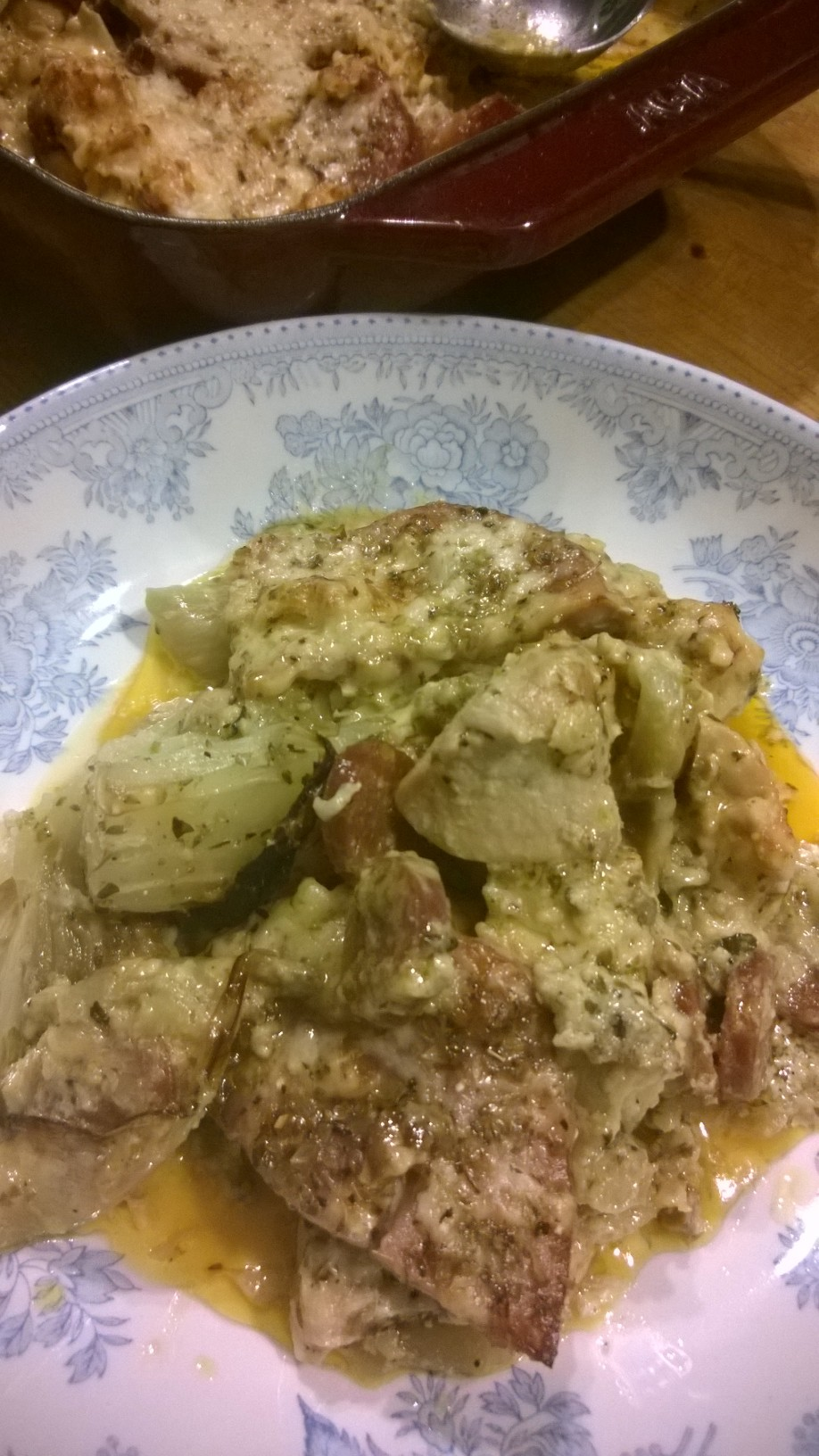
Chicken, Chorizo & Chicory Gratin with Smoked Ham, Brie & Emmental. One-Pot Low-Carb Comfort Food!

gratin

Okay, so I like things that rhyme! But believe me; that’s certainly not the motivation behind this dish. So what is? Taste. Quite simply put; it’s delicious!

I never begrudge the complexity of multi-component dishes (like lasagne), where 3 saucepans & a brigade of roasting-dishes are required. Nor do I bemoan the washing-up; if you want good home-cooked food, then it’s par of the course. But sometimes I must admit that one-pot dishes are a godsend! This is never more the case than when you’re late home from work and all you want to do is relax. So if that’s tonight, then this is the dish for you!

Not only is this recipe the ultimate in ease and convenience, it’s also very low in carbohydrate. This means that diabetics and those on a ketogenic-diet can share in the easy-life, as well as gluten-intolerants and paleo-fans!

Feel free to substitute any of the ingredients, but it’s certainly worth sticking with the chicory and chorizo, as they both add hugely to the flavour.  Chicory (I believe Americans may call endive) has a slightly sharp flavour, which makes it brilliant for things like gratin where the taste will ‘hold its own’ amidst the cheese. Chorizo adds a bit of denseness to the texture and has that deep Spanish earthiness, which lies at the heart of comfort food. The chicken is inter-changeable for pork, turkey or even seafood. If you come up with any triumphs, be sure to let me know!

This dish is rendered far more straight-forward if you have a roasting-dish that can be used directly on the hob-top.

Place your dish onto the hot-plate and drizzle in a glug of olive-oil. Add your chicken-pieces and brown slightly, before mixing in a couple of handfuls of very roughly chopped shallots or onion. This is followed by crushed garlic and a good shake of dried oregano.

Halve your chicory lengthways and add it to the pan. Give the whole lot a good stir to coat with the oil, then leave to cook a few minutes until the chicory wilts down a little. Sprinkle over sliced chorizo, then layer on slices of thick-cut ham. Season well then place the dish into the oven for 30 minutes, until the endive is beautifully soft and the ham just starting to colour.

At this point, pour in a cupful of double-cream and dot the surface with slices of brie. Grate a flourish of emmental and parmesan on top, then back into the oven it goes for the dish to brown-up until it’s sizzling and golden all over.

Serve with a light salad and a big appetite! You’ll need it, as everyone tucks in for seconds!

Thank you for reading an bon ap!

Adam.

Pan-Seared Fillet of Cod in a Cream-Cheese & Vermouth Sauce, Served with Parmesan Shavings & Fresh Basil – rich, decadent low-carb!

cod in vermouth


I’ve always been enchanted by the very Victorian concept of a fish-course. There’s something incredibly luxurious and decadent about it – a whole chapter of a meal dedicated to one element alone. By the mid-Victorian period, the advance of the railways meant that a ready supply of fish ‘on-ice’ could be supplied to the inland cities. This introduced an abundance of fresh seafood to the urban dining-plate and provided a cheap form of protein to the masses (fish & chips!).

One of the great joys of a fish-course such as this, is that it’s super fast to prepare because fish cooks so quickly. It’s also incredibly easy to do, with very little fuss. This recipe can equally be served as a starter or luncheon dish. Team it with fresh salad or steamed green vegetables such as beans, broccoli or mange-tout. Because it’s low in carbohydrate, it can be enjoyed by those on a ketogenic diet, diabetics, paleo-fans & gluten-intolerants. There’s no excuse therefore – go ahead & give it a go!

Thinly slice a couple of shallots and crush 2 cloves of garlic. Soften these in a saute-pan in plenty of butter. Once translucent, add your cod to the pan. There’s no need to turn the fish, so just clear a space amidst the onions and place it in. Turn the heat up and pour on a good glug of vermouth (unsweetened), followed by a little water. You want the liquid to come up to ‘waist-height’ on the fish. Season the sauce and place the lid on the pan for three to five minutes, depending on the thickness of your fillets.

You’ll know the fish is done when it starts to ‘flake’ on top. Because we’re not turning it, this is our sign that it’s cooked all the way through. Spoon in a couple of tablespoons of cream cheese and stir to dissolve the lumps. Lift the fish carefully onto a warmed plate with a fish-slice or palette knife. Then quickly transfer the pan to the hot-plate and give the sauce a quick blast to fully incorporate the cream cheese & reduce. Finally, finely chop some fresh-basil and add this to the sauce, checking one last time for seasoning.

Ladle your sauce over the fish and shave on generous curls of parmesan cheese. Rush straight to the table and enjoy. Delicious, delicious, delicious!

Thanks for reading and bon ap!

Adam.


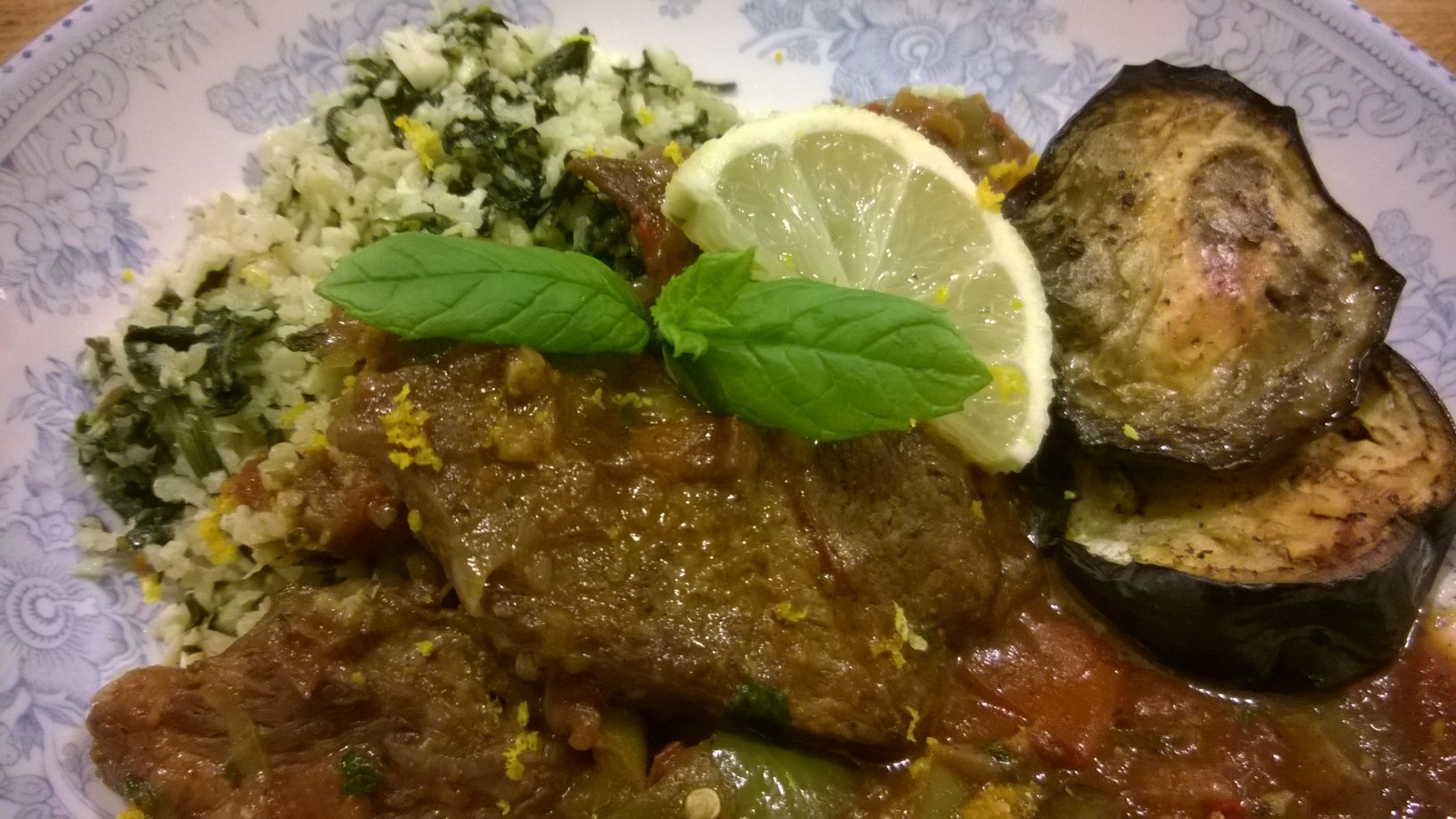
Fragrant Moroccan Lamb Tagine with Roasted Aubergine. Effortless, exotic, low in carbs, high in taste!

lamb tagine

Moroccan food is one of my absolute favourites. The flavour-profile is so incredibly deep & exotic, that just one bite alone immediately transports you to another world!

Tagine is the ultimate example of this richly fragrant cuisine. In this dish, the earthiness of spices is balanced & lifted perfectly by the clean, fresh taste of mint & lemons. Cumin and tomato lend the dish a comforting warmth, which is hugely welcome on a cold wintry evening such as this. Even though it’s cold and dark outside, the kitchen can still be a place of sunshine, filled with the heady aroma of spices and perfumed scents of distant climes…

People are often put off cooking tagine due to the length of time it requires in the oven. Well you’ll be pleased to know that this version is incredibly quick! It all depends on the cut of meat you use – I used leg-steaks which are infinitely tender and don’t require slow-cooking. Diabetics or those on a ketogenic-diet might also be unnerved due to the high content of dried-fruit (thereby sugar) in all the standard recipes. Here, that flavour & sweetness is provided by orange & lemon zest, which further contributes to the perfumed quality & adds to the dish’s authenticity.

This dish is so quick and easy that you can cook it on a weeknight after work, without spending hours in the kitchen. Whichever day of the week you choose, this recipe will prove an instant winner & soon become a stalwart of your repertoire. I served the tagine with cauliflower-rice, but you could equally forgo this in favour of steamed vegetables such as broccoli or mange-tout.

Firstly, roughly slice an aubergine and sprinkle the slices liberally with salt and pepper. Place them onto a baking-tray and drizzle with olive-oil to coat. Roast in a hot oven for circa 45 minutes, or until golden and soft to the touch.

To make the tagine, season your lamb and seal in hot oil in a pan on the hob. Once browned both sides, throw in a handful of finely sliced onion or shallots, chopped garlic and chilli. Once these start to soften, sprinkle in a teaspoon of ground cinnamon, two teaspoons of cumin, one of paprika and half a teaspoon of ground coriander.  Stir these in, then deglaze the pan with a little port or red wine. This contributes to the rich sweetness of the dish and helps add that all important warmth.

Whilst the wine is reducing, drain half a can of tomatoes, discarding the juice. Add this to the pan, followed by the grated zest of half a lemon and orange. Finely slice a handful of mint and stir this through the sauce and then crumble in a chicken stock cube. Season and test for flavour. If the sauce lacks freshness add a quick squeeze of lemon juice. There should be enough liquid in the pan to come up to the ‘waist’ of the pan’s contents. If water is required, pour on and stir. Then place the pan into the oven for 20 minutes to cook through.

After this, both tagine and aubergine should be ready at the same time. If the tagine is still liquidy, stir in a small amount of tomato purée and reduce on the hob for another minute. Equally, if the chilli flavour is too dominant, add a quick sprinkle of table-sweetener, which will balance the taste. Ladle the lamb onto a plate, with the aubergine piled up beside it. Pour on a generous quantity of the rich sauce and garnish with more chopped mint and lemon-slices.

All that’s left is to enjoy!

Thank you for reading and bon ap!

Adam.

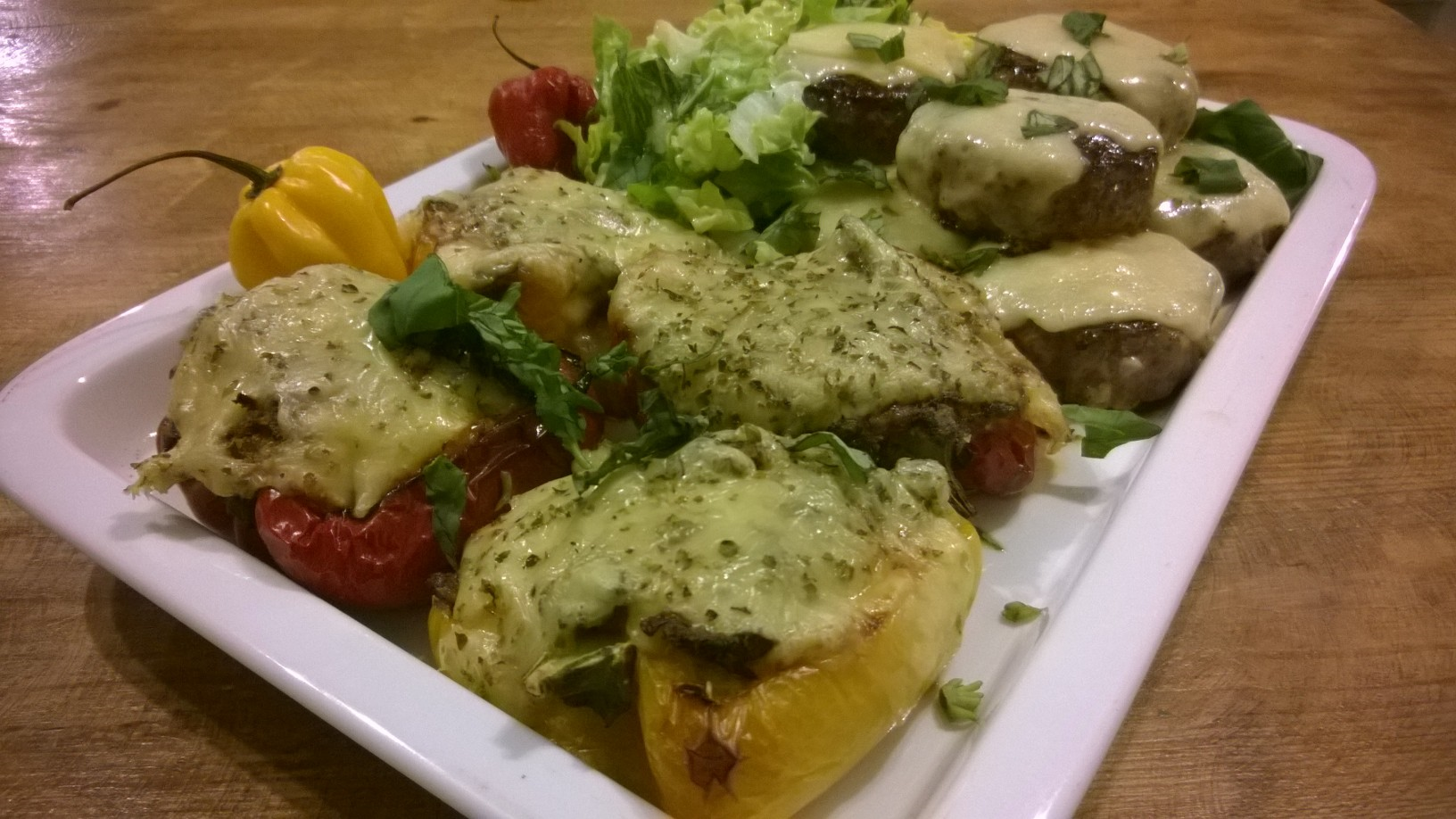
Seared Ground-Beef Cheeseburgers with Stuffed Peppers & Dressed Mixed Leaves. Who says a diet means deprivation? Low-carb certainly has its charms…

stuffed peppers

Who can resist the taste of seared ground beef, topped with sizzlingly melted cheese? Not me! I’m constantly amazed that you can eat this sort of food on a diet. Well that’s the wonder of a low-carb, ketogenic regime – now you can!

Okay, so the levels of cheese in this dish may be a little gratuitous, but on a LCHF diet we certainly shouldn’t be scrimping on fat. It fills you up & provides the essential calories which would otherwise have been gained from carbs.

The stuffed-peppers are something which marries both taste and practicality. Leftovers are a reality of every kitchen, & the low-carb-kitchen is no exception! Last night’s sausage-meat & sage stuffing, that was so delicious with roast chicken; now gets a second lease of life in yet another mouth-watering low-carb dish.

Peppers provide a great opportunity to use up odd bits & bobs which might otherwise prove insufficient to make it on their own. If you don’t have a pre–made mix to use up, then combine what you do have; mix it with a bit of cheese, and hey presto, Bob’s your uncle! Great combinations include tomato, ham & blue cheese, mushrooms, spinach & goat’s cheese, or even mackerel leek & parmesan. Left-over cauliflower-rice or zoodles can happily find a new home; and a second benefit is that all options make you look like a gastronomic superstar! What creativity! The choice is endless!

If you wish to make this from scratch, I include the recipe for the filling immediately below. If you prefer to go off-piste, then feel free to get creative! If you come up with something truly inspirational, be sure to let me know! The only guidance is that you include sufficient oil or butter to soften the peppers whilst they cook. If not, you risk a burnt topping and unpleasantly raw capsicums!

To make the stuffing, finely chop a small onion, half a courgette, and a handful of sage. Add these to a large mixing bowl then stir in a handful of roughly diced mushrooms. Then we add the same volume of bite-size chunks of sausage-meat (or sliced sausage) and circa 100g of ground almonds. Season really well and stir in some dried sage in addition to fresh. Beat an egg and mix this in, so that you have a texture which clumps & sticks slightly together like a lose dough.

Spoon your filling into halved & de-seeded peppers then dot the surface with butter or drizzle on a little oil. Place into a greased roasting-dish and bake in a moderate oven for 40 minutes, topping with a final grating of cheese for the last 10 minutes. When the peppers are soft to the touch and the surface is bubbly & browned, remove from the oven and place onto your pre-warmed serving-dish.

Whilst the cheese is browning, place a griddle-pan or frying pan onto the hob to heat through. Once piping hot, sear your burgers, between 1 to 3 minutes each side, depending on how you like them cooked (1 minute for rare, 3 for well done). Once you’ve turned them, top each burger with a slice of cheese to melt slowly whilst the underside cooks.

When seared to perfection, scoop out of the pan with a sturdy fish-slice and serve next to your peppers and garnish with dressed leaves. What could be better? The perfect quick, hassle-free, low-carb dinner for a cold and wintry evening!

Thanks for reading and bon ap!

Adam.

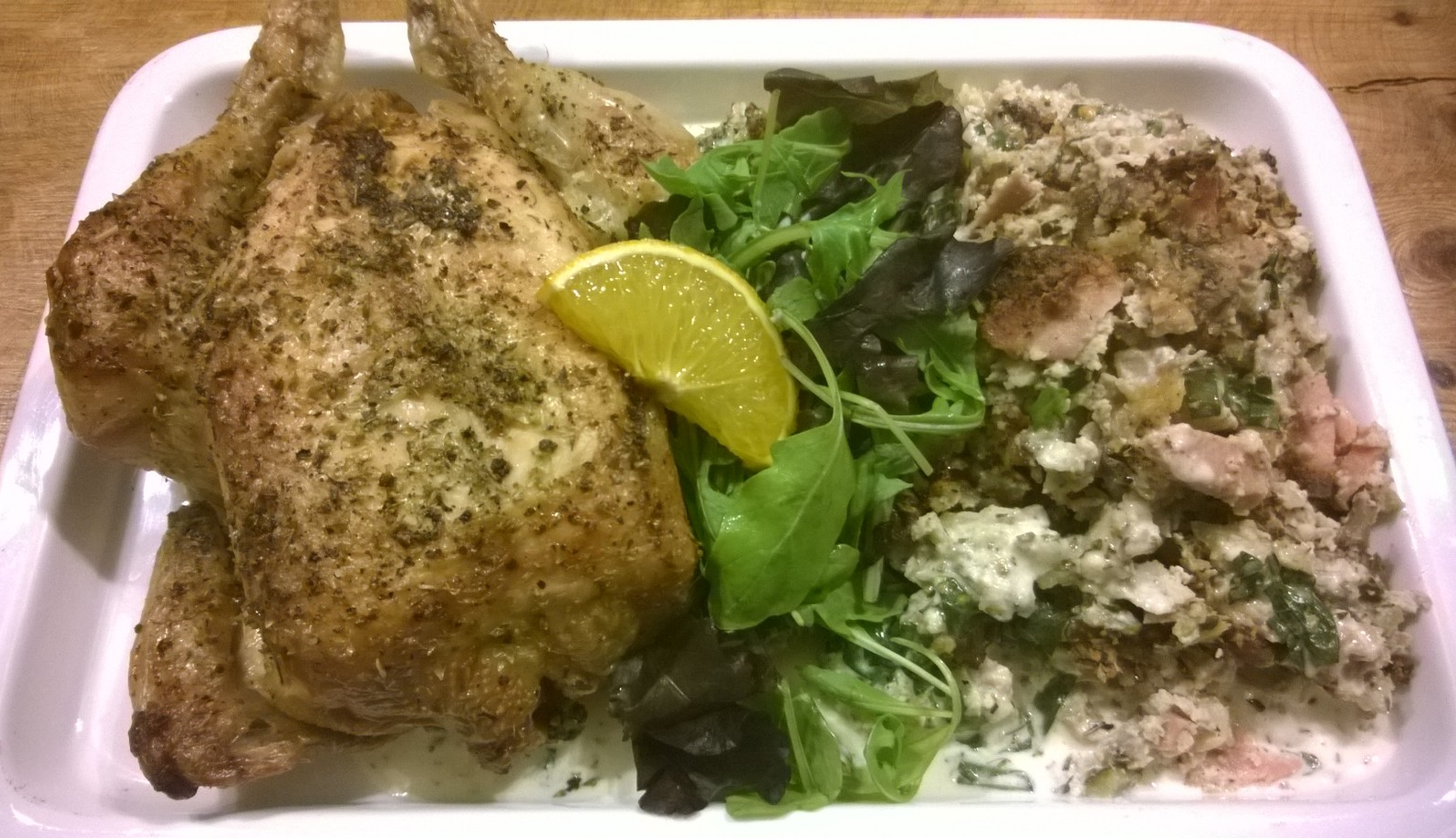
Slow-Roasted Chicken with Sausage, Sage & Onion Stuffing & Rich Gruyere, Parmesan Mornay. A traditional English classic, just minus the carbs!

chicken

Food must occasionally have that all important sense of nostalgia; and low-carb cooking is certainly no different! For as long as the English have roasted chickens, the combination of sage and onion have partnered them with outstanding & mouth-watering results. All three flavours are so warm and inviting that they speak ‘comfort’ with every mouthful.

The stuffing I’ve prepared here could equally be used as a main course in its own right, served with vegetables as a form of mushroom & almond meatloaf. The texture is dense and filling with a pleasing crunch on top; something so often lacking in low-carb cuisine.

This is another dish where you’ll find it hard to believe that it’s ‘diet-food’. The recipe is so rich and satisfying, you’ll return to it time and time again. And because it’s virtually free from carbs, it’s ideal for diabetics, ketogenic-dieters and those with an intolerance to gluten. Why not pretend that you’re all three, so you can eat like this every night!

Start by seasoning your chicken all over, then place it breast-side down into an oven-dish. Roasting the chicken upside down for the first hour will mean that all the fat and juices sink down into the breast, preventing it from being dry. Once golden and brown on the underside, turn the chicken over and re-season the top, making sure to provide enough salt that the skin crisps up and turns a fine, succulent bronze. This will take a further half hour to 45 minutes.

Whilst the chicken is roasting, make your stuffing. This couldn’t be easier. I’ve made a large amount to use as leftovers later in the week, but you could roughly halve the ingredients if you wanted to make less & eat it all up in one go.

Finely chop an onion, one courgette, and a handful of sage. Add these to a large mixing bowl then stir in 2 handfuls of roughly diced mushrooms, the same volume of bite-size chunks of sausage-meat (or sliced sausage) and circa 400g of ground almonds. Season really well and stir in some dried sage in addition to fresh. Beat three eggs and mix these in, so that you have a texture which clumps and sticks together like a lose dough.

Butter a baking-dish, then spread your mixture to minimum one centimetre in depth. Generously spot the top with knobs of salted butter, then bake for 1 hour, until brown and crunchy on top, and wonderfully aromatic!

Take your chicken out of the oven to rest covered in foil for ten minutes. Whilst the meat is resting, make your cheese sauce. Heat a cupful of cream in a saucepan, then add half a cup of grated gruyere and a third of a cup of parmesan. Grind on black pepper and add a handful of finely chopped sage and basil. Reduce on the hob for 5 minutes until thick and glossy.

Take your stuffing out of the oven and pile up beside your chicken. Pour half of the sauce over the stuffing, keeping the other half for people to serve themselves at the table.

Few things can be more heart warming and delicious that hot roasted chicken with sage. Low-carb dining doesn’t get any better than this!

Thank you for reading and bon ap!

Adam.

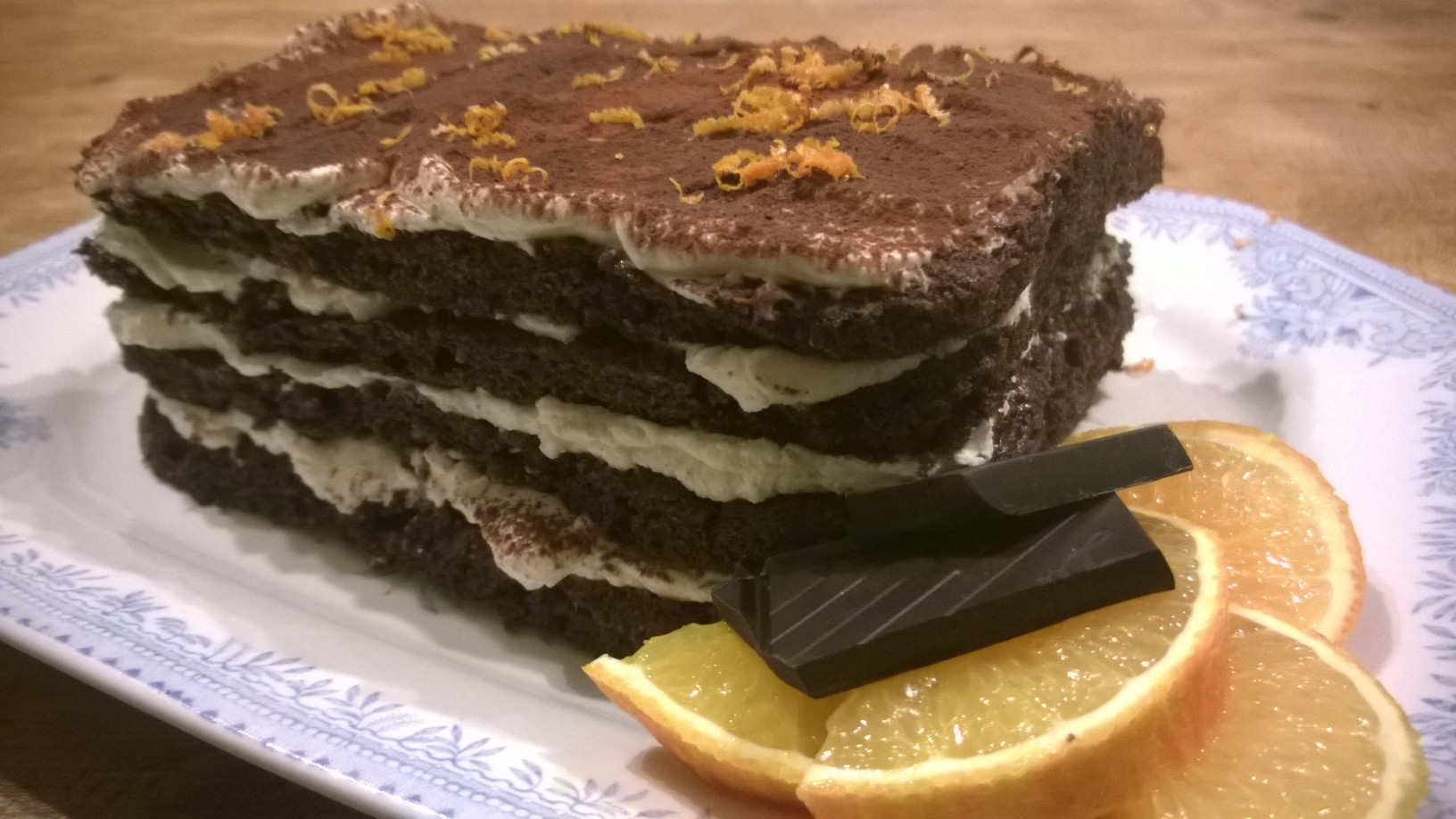
Indulgent Dark Chocolate Orange Layer Cake – a low carb, diabetic-friendly slice of paradise!

layer cake

Sometimes in life, actions speak louder than words. Well, my type-1 diabetic partner just dug into a large second-helping of this cake without even hesitating. Though I say it myself, this recipe is truly delicious; far better than my poor photography will ever convey. The carb-count is incredibly low, so it’s perfect for a ketogenic diet. But there’s also one other plus point – it’s quick! From weighing-scales to cooling rack in half an hour. That means you can make it any day of the week, even on a ‘late home from work’ Monday evening…

Chocolate and orange is a match made in heaven. This recipe relies on dark cocoa powder to add depth of flavour, and grated orange zest to give it that beautifully ‘fresh and fragrant zing’. If you’re not a fan of orange, you can equally keep the flavour to a vanilla base, or mint would work just as nicely. So without further ado…

Measure 4oz of xylitol sweetener into a bowl. I always use xylitol in baking. In my experience, it’s the only sweetener which retains its sweetness once cooked; and its granular texture means that it behaves exactly like sugar in cake-recipes. Cream this with 4oz of unsalted butter, then mix in 2 beaten eggs. When smooth, fold in 4oz of ground almonds, a half-teaspoon of baking-powder and 1.5oz of good quality cocoa. The texture should be a spreadable, if reluctant dropping-consistency.

Line two 9×7 inch baking-trays or one larger tray. Spread the mix thinly so that it just covers the bottom of the tray. Bake in a moderate oven for 15-20 minutes until the cake is resistant to the touch and springs back when pressed. I would certainly check after 15 minutes – as this is a layer-cake, we’re not anticipating much ‘rise’. The trays’ shallow depth and large surface area will mean this cooks quickly!

Whilst your cake is cooling on a wire-rack, make your icing. Take 10 and a half ounces (300ish grammes) of cream cheese and place into a mixing-bowl. Shake in a half-cupful of powdered table-top sweetener (not xylitol, as the icing is not being cooked); a cupful of whipping-cream, a half teaspoon of powdered vanilla-seeds & the zest of an orange. Whisk these together until thick and spreadable. Taste for sweetness, adjusting if necessary.

Once your cake is thoroughly cool, cut each rectangle in half; or if you baked it all on one tray, cut this into four equal oblongs. Place your first layer onto your serving-plate then spread a generous coating of icing atop the cake. Place your 2nd layer above this, and repeat until all four slices and icing are used up. Finally dust with cocoa-powder and a last sprinkle of orange-zest. Voila!

Few things can beat this recipe. It’s totally delicious. Don’t just take my word for it however; try it yourself. When you do, let me know you get on. If it’s not the best low-carb cake you’ve had all week, your money back!

Thanks for reading and bon ap!

Adam.

Avocado, Bacon & Blue Cheese Salad with Tangy French Vinaigrette – Low Carb Heaven!

avocado salad

Salads needn’t be complex or involve hundreds of finely chopped ingredients to be flavoursome. Besides the vinaigrette, this dish contains just four ingredients: smoked-bacon, lettuce, blue-cheese and avocado. If you’re worried that its simplicity might detract from its flavour; don’t be. It’s delicious! Take my word for it.

I mainly prepare this recipe as a starter. But because it’s so quick and easy, it also makes a wonderful lunch dish for when time is tight. My recommendation is to make a large batch of dressing, from which you just serve a good glug every time you’re preparing a salad. A bottle of home-made vinaigrette will keep for months and is infinitely better than anything you can buy. Again, take my word for it!

Place rashers of smoked streaky bacon onto a baking sheet and oven until brown and crisp. I should say circa 15 minutes, but this very much depends on your oven. Whilst this is cooking, make your vinaigrette.

Crush a small clove of chilli into a mixing-bowl, then add a dessert-spoon full of Dijon mustard. Judging the quantities roughly by eye, add the same volume of lemon-juice as you see mustard in the bowl, then grind in pepper and a good crunch of sea-salt. Now sprinkle in a tablespoon of chopped parsley. Judging by eye again, pour in white-wine vinegar until you have the same quantity of vinegar to all other ingredients. Place the bowl onto a damp tea-towel to stop it moving, then whisk in sunflower-oil, drizzling this in slowly so that the dressing doesn’t separate. If it does, then no great shakes; it’s only visual appeal that’s compromised, not taste. Once you have circa 10 times your pre-oil volume of dressing, stop and have a quick taste on the tip of a spoon. It should be pleasingly acidic, but not ‘wincingly’ so. If too strong, simply continue to whisk in oil until you’re happy with it!

Once done, remove the bacon from the oven to cool.

Scatter salad-leaves into your serving-dish, then place your de-stoned avocado on top. The best way to prepare avocado is to halve it lengthways then hit the stone with the blade of your knife. A quick twist anticlockwise will instantly remove it, enabling you to simply scrape the avocado out of its skin with a soup-spoon.

Dice your blue-cheese and strew this over the avocado and lettuce. Slice your bacon into inch-length-strips and toss these over the other ingredients. Finely pour a generous glug of vinaigrette all over the dish and finish with a grind of pepper.

This dish is so unbelievably simple yet tastes fantastic. I can’t recommend it highly enough. Once you’ve had a go, be sure to let me know how you got on.

Thanks for reading and bon ap!

Adam.

Jamaican Jerk Chicken with Spinach & Coconut Cauliflower-Rice – exotic low-carb flavours from around the world!

jerk chicken

Some dishes are so steeped in culture & tradition that tracing their origins to find the one true ‘definitive recipe’ is nigh on impossible. Jerk-chicken is one such thing. The millions of variants all proclaim to be ‘original and authentic’, all using an extra shake of this or a secret touch of that. The one thing they all have in common however is the inclusion of allspice and scotch-bonnet chillies!

My diabetic-friendly interpretation makes no claim whatsoever to be authentic or original. What is does claim though, is to be every bit as delicious as its high sugar counterparts. I also claim ease, speed and incredibly low levels of carbohydrate. What more could you want?

Before I go into the recipe, just a quick word about allspice. Please forgive me if I’m preaching to the converted, but this was once a gap in my own knowledge-base. I therefore feel honour-bound to rescue others from the quagmire of ignorance which once plagued my own cooking know-how. Allspice is a berry, dried then ground into a powder. It is not a spice-mix, made up of generically blended ‘Christmassy’ spices, for use in mince-pies &tc. That is mixed spice! Sorry again if you already knew this; I shan’t mention it further. Consider yourself well & truly told!

Start by making your marinade. Into a large mixing-bowl, add 3 cloves of crushed garlic, 2 finely chopped scotch-bonnet chillies, 1 tablespoon of allspice, 3 tablespoons of lemon-juice, a teaspoon of dried thyme, 2 tablespoons of sunflower oil, a handful of finely chopped spring-onions and a heaped tablespoon of xylitol sweetener. Hot chilli requires quite a bit of sweetness, so don’t hold back on the xylitol! Mix these all together, then add your chicken to the bowl. You can blitz the paste until smooth in a food-processor if you like, but I personally prefer it more textured. Cover with a tea-towel and leave to stand for between an hour and a day. It’s completely up to you. Just bear in mind that flavours develop in intensity the longer they’re allowed to imbue.

Heat a glug of oil in a thick-bottomed pan, then add you chicken when the oil is piping hot. Whilst it browns, finely slice onion and peppers and add these to the pan. Once one side is done, turn the chicken and continue to caramelise the underside. After a couple of minutes, pour on half an inch depth of water, and place into the oven for 20 minutes, or until the liquid has reduced.

Meanwhile, make your cauliflower-rice. Instructions for this can be found in another blog as follows: cauliflower-rice. The only thing you do differently for this recipe, is add a tablespoon of coconut-oil to the butter, and throw in a handful of dessicated coconut whilst the rice is cooking. Microwave fresh or frozen spinach, then add this to rice, stirring through at the last moment.

Pile the rice into your pre-warmed serving-dish, then spoon the chicken and sauce all over it. Finish with a final flourish of coriander, or chopped herb of your choice. The taste should be hot, spicy, sweet, aromatic and incredibly morish! This dish is very difficult to leave alone if it’s looking like there’s leftovers. Good job then it’s low carb!

Thanks for reading and bon ap!

Adam.

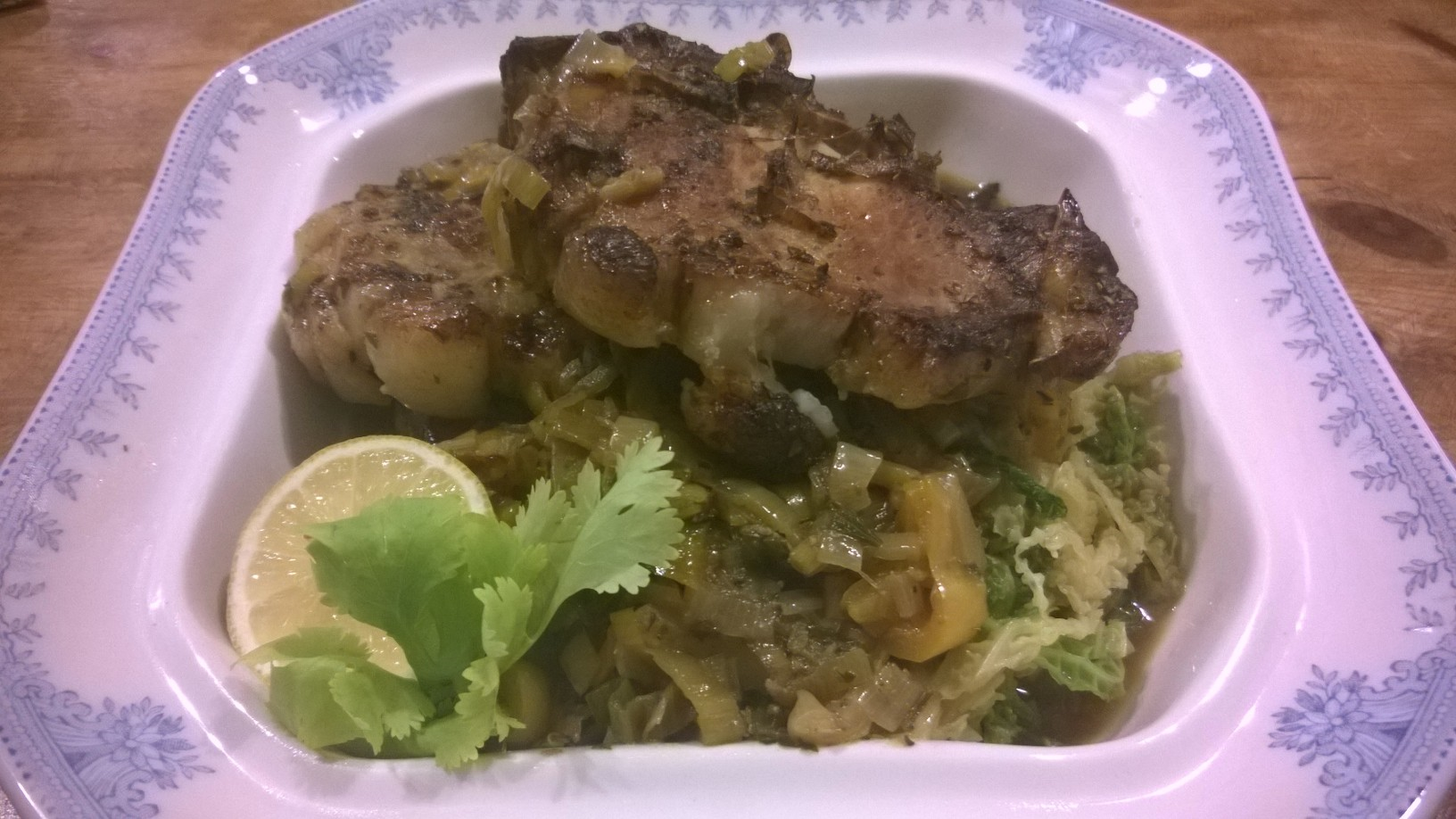
Normandy Pork Calvados with Buttered Savoy – a low-carb dish with true pedigree!

pork calvados

When people refer to French cookery, they don’t mean a list of complex ingredients or fiddly, time-consuming recipes. They’re actually referencing a way of cooking. French cuisine is a methodology; a time-honoured discipline, designed to bring the best out of ingredients. When the French refer to the ‘art of cookery’; art in French means type or style. The ‘French-style’ requires the mastery of a few basic techniques which, once learnt; will deliver consistently outstanding results.

One of these competencies is the classic French method of cooking meat. There’s a stately ritualism to this process, which is almost comforting in its cadences. The succulent sealing-in & caramelisation of the meat is followed by the slow softening of shallots & garlic; then deglazing the pan with a magnificent whooshing ‘sigh’, as wine hits the thirsty metal-surface of the pan. As the kitchen fills with the delicious aroma of melting butter, fresh herbs and pan-seared meats, you’ll begin to feel like an alchemist creating pure gold from the very simplest of ingredients. It is truly an art worth learning!

This dish calls on the heady Normandy digestif calvados to bring out the sweetness of the pork and deliver depth to the sauce. Apples may be off the list on a low-carb diet, but a good glug of calvados reduced down in the pan certainly won’t impact the blood-sugar. This dish pays tribute to the classic affinity between pork and apple, that’s enchanted the taste-buds for hundreds of years past. What could be more welcoming on a cold Autumn’s evening that this?

Bring your pork to room-temperature and season well both sides. Heat a metal-lined sauté-pan on the hob (non-stick doesn’t deglaze with pleasing results) and throw in a knob of salted butter followed by a dash of oil. The sizzle should be a rewarding sensation in itself, as should the aroma. Add your pork to the pan and seal on each side until it’s golden brown and deliciously caramelised. You must excuse me for constantly repeating myself, but it needs to be said…! Do not fuss around with the meat in the pan or move it until it’s good and ready. No-one likes to be mothered; why do it to your dinner?! When the pork is ready to be turned, it will release itself of its own accord in response to the merest touch with finger or wooden-spoon. If it sticks, it’s not ready. We want the meat to caramelise and brown; not steam! And do not crowd it in the pan or the same will happen!

Once the meat is beautifully golden on each side, lift out of the pan and tip in sliced shallots, leek & chopped garlic. Soften these until translucent and just starting to brown, then crank up the heat as high as you can. This is not some obscure act of retribution, you simply want the pan to be as hot as possible for when you pour in the spirits. That way, you’ll deglaze with the maximum effectiveness, lifting all the caramelised flavours straight off the bottom of the pan. Once it’s good and hot pour in your measure of calvados, making sure to stand over the pan and enjoy the cloud of sweet, alcoholic steam which billows beautifully out into the kitchen! Once the liquid has all but evaporated, pour in a 3/4 inch depth of chicken stock (or water and stock cubes) and place your pork back into the pan, ensuring it’s surface is not submerged. Dissolve a small teaspoon of Dijon mustard into the pan and add a bay-leaf or two for warmth. Reduce this down for 20 minutes until the sauce is barely lapping the top of the vegetables then stir in a good handful of chopped parsley.

Whilst the sauce is reducing, thinly shred your cabbage and give it a good rinse. Add butter to a fresh pan and briefly sauté crushed garlic until soft but not brown. Place the cabbage into the pan, retaining what little water is clinging to the leaves after rinsing. Season, then fit the lid on firmly. Steam for three to five minutes, then spoon into your pre-warmed serving-dish.

Arrange your pork atop the cabbage, then test the sauce for seasoning. There are two schools of thought on this dish – cream or no cream. I have not added it, as I like the sauce to retain the clean taste of apples. If you like however, add a swirl of double cream at the final stage of cooking. This adds richness and the luxurious touch of velvet. It is entirely a matter of preference and a decision I leave completely up to you. Give it a go both ways and get back to me with your results.

Whichever way you’ve chosen to finish your sauce, pour this liberally over the pork and cabbage, then garnish with a final flourish of chopped parsley. Classical comfort food at its best! The results certainly won’t disappoint.

Thanks for reading and bon ap!

Adam.

Classic Prawn Cocktail – a much loved favourite, just without the carbs!

prawn cocktail

You may or may not know that the ‘Marie Rose’, or ‘Cocktail Sauce’ which accompanies a prawn-cocktail was first created by Fanny Cradock in the 1960s. Her original sauce was made from tomatoes, mayonnaise, Worcestershire sauce, lemon-juice and pepper. Subsequent versions have been simplified to just tomato-ketchup and mayonnaise, which is now the standard version used.

Ketchup contains sugar, which is ‘off limits’ to diabetics and those on a ketogenic diet. My version of this classic therefore substitutes the ketchup for tomato purée. This makes it low-carb but every bit as delicious.

To make the sauce, take two heaped tablespoons of mayonnaise and squeeze in a good tablespoon of lemon-juice. Grind in black pepper, then add a teaspoon of tomato-purée. Mix the ingredients thoroughly until smooth. Next stir in half of your prawns, keeping the rest aside to garnish.

Form a bed of lettuce in your salad-bowl. Inch-length chunks of celery laid on top of this add a pleasing textural variation. Quickly drizzle vinaigrette or olive-oil over the leaves, then spoon your prawns-in-sauce all over the salad. Arrange the remaining prawns at intervals across the surface, keeping the tails-on for decoration.

Sprinkle a few cubes of feta over the dish and finally shave a flourish of deliciously-salty parmesan over the top. A good squeeze of lemon sees the dish complete!

Prawn-cocktail must be the ultimate late-twentieth-century starter; one that time has been unable to diminish. If you haven’t had it for a while, then try it as above. You’ll soon be reminded what’s kept the dish so universally popular for the last 50 years!

Thanks for reading and bon ap!

Adam.

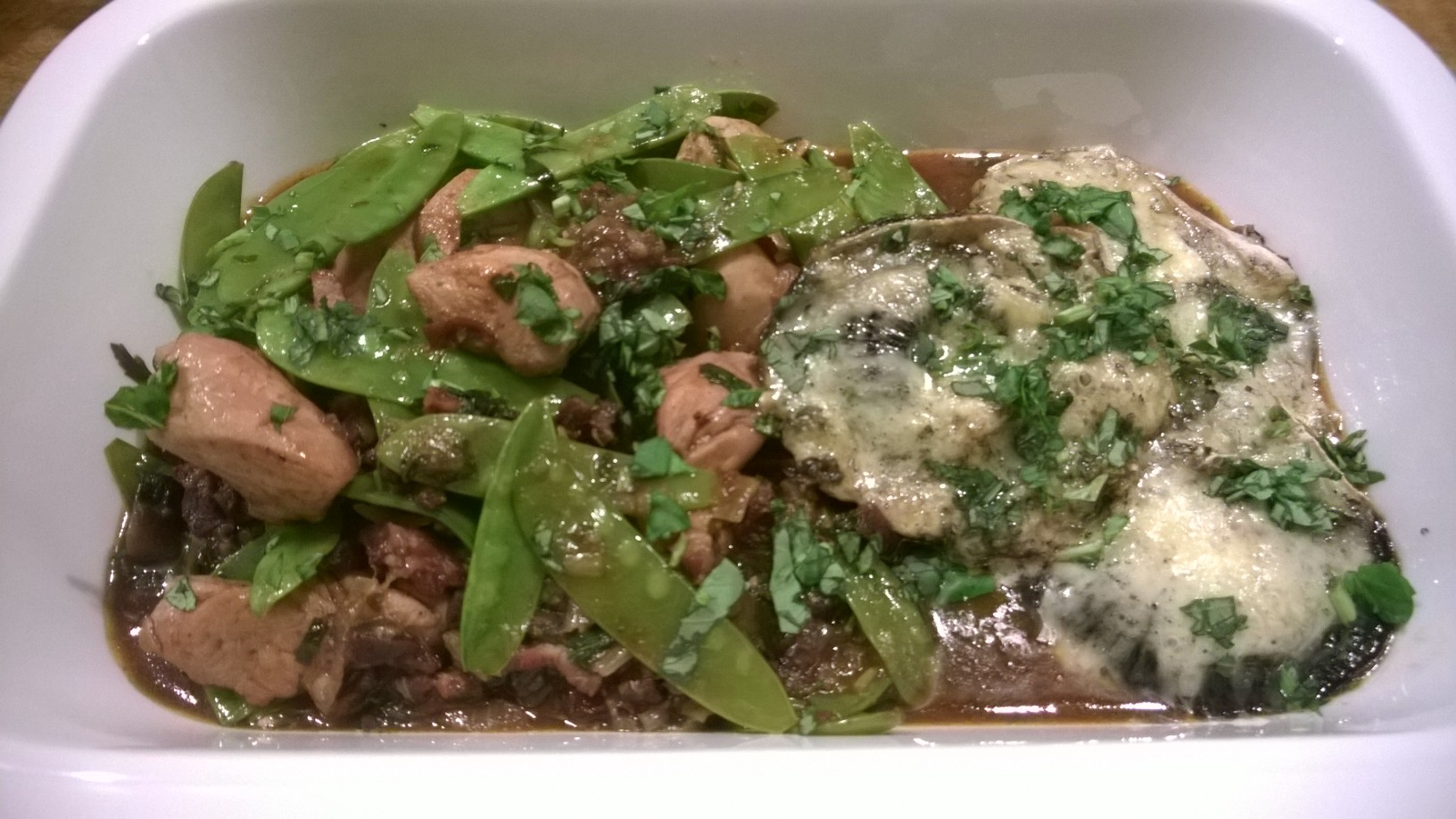
Classic ‘Quick’ Coq Au Vin with Blue-Cheese-Baked Garlic Mushrooms – Low Carb ‘Nutrition with Tradition’

coq au vin

You can’t beat a classic; but you can speed it up! Coq-au-vin is traditionally cooked with meat on the bone (thighs, drumsticks &tc). Although delicious, when you’re late home from work on a week-night; we don’t all have that luxury of time. But this doesn’t mean we can’t enjoy a satisfying home-cooked meal!

This dish sees the chicken cooked on the hob (far quicker than in the oven) . I use diced breast-pieces to speed things up a notch. You can of course revert to slower-cooked cuts of meat if you don’t have time constraints; but as it’s a Thursday-night, I’m opting for the faster version!

Start by sautéing chopped bacon (lardons) in a thick-bottomed pan. If more fat is required to prevent the bacon from sticking, then add a knob of butter and a splash of oil. Once browned, add your chicken-pieces.

Chop onions or shallots into hearty chunks and add these to the pan. Follow this with a little chopped garlic. Once the chicken and vegetables are nicely brown, deglaze the pan with a little red-wine. Once this is almost reduced, pour on water until the chicken is shoulder-high in liquid. Season well and crumble in a stock-cube.

Whilst your stock is reducing, place your mushrooms on a baking-tray and crush a little garlic onto each. Top this with a knob of button, season generously, then into the oven it goes. After 15 minutes, add slices of blue cheese, then bake for a further 10-15 minutes until the cheese is gloriously sizzling and just starting to brown.

By this time, your chicken should be almost ready. Add a squeeze of tomato purée and a good handful of mange-tout. Place a lid on the pan and steam the vegetables in the sauce for two minutes until al dente.

Ladle the chicken onto your serving-dish and position the mushrooms beside it. A final flourish of chopped parsley completes the job, and dinner is served!

All in all, a meal fit for a king (and a low-carb one at that!).

Thanks for ready and bon ap!

Adam